Introduction
On September 8, 2026, the results of PISA 2025 were released. It was the largest administration in the history of the program: more than 760,000 students representing about 33 million 15-year-olds in 91 countries and economies (Organisation for Economic Co-operation and Development [OECD], 2026b, p. 3). The diagnosis leaves little room for complacency. PISA 2025 recorded the lowest OECD average ever observed in science, reading, and mathematics, and reading has been declining since around 2012, with the decline accelerating after 2018 (OECD, 2026b, p. 25). Across the 35 OECD countries with comparable data, the mean reading score fell by 11 points between 2018 and 2022 and by a further 14 points between 2022 and 2025; according to the OECD itself, the cumulative 25 points mean that 15-year-olds in 2025 read at the level that could have been expected of 14-year-olds seven years earlier, that is, with a delay of at least one year in the development of their reading competence (OECD, 2026b, p. 308). Of 74 education systems with comparable data, 56 show statistically significant declines over that period, and only five improved.
The nature of the decline is as revealing as its magnitude. A detailed analysis of student responses shows that, between 2018 and 2022, the deterioration was concentrated on long texts and on tasks that require evaluating, reflecting, and integrating several pieces of information, whereas locating isolated pieces of information held up better; by 2025, the decline had become more uniform across cognitive processes, but text length remained a decisive factor (OECD, 2026b, pp. 312–313). At the same time, the proportion of fast and incorrect responses rose by more than four percentage points, and the share of "hasty readers" in the reading-fluency test increased from 6.6% to 11.4% (OECD, 2026b, pp. 313–314). The OECD concludes that the trend is unlikely to be a measurement artifact and that its defining feature is students' declining capacity to read carefully and to sustain attention over relatively long periods (OECD, 2026b, p. 318).
For Mexico and Latin America, the problem is both older and more acute. Mexico scored 408 points in reading, compared with an OECD average of 461, and half of its 15-year-old students (50.2%) performed below Level 2, the baseline proficiency threshold—the highest proportion since 2003 (OECD, 2026b). In the region, nine of the twelve systems with comparable data show significant reading declines relative to 2018 (or to 2017, for the countries that took part in PISA for Development), and in ten of thirteen countries at least half of the assessed students do not reach baseline proficiency (see Table 1). These figures come on top of an earlier crisis in foundational learning, deepened by prolonged school closures during the COVID-19 pandemic (Betthäuser et al., 2023; Hevia et al., 2022).
In public debate, the diagnosis is often attributed to smartphones, social media and, since 2022, generative artificial intelligence (AI). The hypothesis is plausible, but it also carries risks: the history of media research is marked by cycles of alarm that confuse correlation with causation and divert attention from structural determinants such as poverty, the quality of teaching, or the disruption of schooling (Odgers, 2024; Orben et al., 2022). The OECD itself cautions that its data cannot determine whether the decline reflects a less central role for reading at a time when language models instantly summarize long documents and audio and video replace written text (OECD, 2026b, p. 318). Between technological determinism and denial of the problem lies a space that can only be filled by a rigorous synthesis of the evidence.
Despite the abundance of studies on screens, digital reading, and AI in education, no review has integrated three bodies of knowledge that are usually examined separately: (a) the most recent evidence from large-scale assessments, including the PISA 2025 results released only weeks ago; (b) experimental, longitudinal, and meta-analytic research on the mechanisms linking digital devices and generative AI to reading comprehension and the cognitive processes that sustain it; and (c) the institutional and policy context of Mexico and Latin America, where learning gaps are wider and the resources to close them are scarcer.
The aim of this article is to produce a critical state-of-the-art review of the evidence published between 2021 and 2026 on the decline in reading comprehension and its relationship with digital devices and generative AI, and to derive evidence-based strategies for Mexico and Latin America from it. Three research questions are addressed: (RQ1) What do the most recent data, particularly PISA 2025, reveal about the magnitude and nature of the reading decline, with an emphasis on Mexico and the region? (RQ2) What mechanisms link the use of digital devices and generative AI to reading comprehension, and how robust is the supporting evidence? (RQ3) Which strategies have evidence of effectiveness, and how can they be adapted to the conditions of Mexico and Latin America?
The article makes three contributions. First, it offers one of the first syntheses to incorporate the PISA 2025 results, with a secondary analysis of the official tables that distinguishes statistically significant changes from nonsignificant ones and considers the expansion of enrollment coverage as an alternative explanation. Second, it proposes an integrative conceptual model, the 4D model—displacement, distraction, depth degradation, and cognitive delegation—together with falsifiable propositions to guide future research. Third, it translates the evidence into a roadmap of tiered strategies, with explicit levels of certainty, for the education systems of Mexico and Latin America.
Theoretical Framework and Background
Reading Comprehension as a Complex Capacity
Comprehending a text is not a matter of decoding words but of building a coherent representation of its meaning by integrating explicit information, inferences, and prior knowledge. That construction rests on demanding cognitive processes—sustained attention, working memory, inference, and metacognitive monitoring of one's own understanding—that develop through prolonged practice with extended texts. Digital environments raise the bar further: in addition to understanding, readers must navigate across sources, distinguish facts from opinions, and judge the credibility of information. Using PISA 2018 data, the OECD showed that only 9% of 15-year-olds in its member countries had a proficiency level sufficient to successfully distinguish facts from opinions on the basis of implicit cues about content or source, and stressed that the development of reading skills had fallen far behind the transformation of the information ecosystem (OECD, 2021). This dual demand—reading in depth and reading with judgment in an information-saturated environment—is the backdrop of the current debate.
A Trajectory of Lagging Achievement That Predates the Pandemic and Artificial Intelligence
The decline observed in 2025 is part of a long history of lagging achievement. In Mexico, reading performance in PISA has fluctuated between 400 and 425 points since 2000 without sustained improvement over two decades (Figure 1). In the region, the 2019 Regional Comparative and Explanatory Study (ERCE), administered to about 160,000 third- and sixth-grade students in 16 countries, found that 44.3% of third graders and 68.8% of sixth graders did not reach the minimum proficiency level in reading, and that the region had not progressed significantly since 2013 (Oficina Regional de Educación para América Latina y el Caribe de la UNESCO [OREALC/UNESCO], 2021). Mexico performed above the regional average, but about 37% of its third graders and 58% of its sixth graders did not reach that level, and the country was among those whose sixth-grade results declined between 2013 and 2019 (OREALC/UNESCO, 2021, 2022). In that same year, before the pandemic, learning poverty—the share of children who cannot read and understand a simple text by the end of primary school—was estimated at 52% in Latin America and the Caribbean (World Bank et al., 2022). In PISA 2022, 55% of Latin American students were low performers in reading, compared with 26% across the OECD, and Mexico was one of only two countries where the share of low performers increased significantly between 2012 and 2022 (Arias Ortiz et al., 2024).
This background is decisive for the argument of this article: the deterioration of reading comprehension in the region predates both the arrival of generative AI and the pandemic, and it coexists with foundational literacy deficits that no technological restriction, on its own, can correct.
Three Cumulative Shocks
On top of this lagging base, three shocks accumulated in little more than a decade, affecting the cohorts assessed in PISA 2025, born in 2009 and 2010.
The first is smartphone-centered connectivity. In 2025, 86.1% of Mexicans aged six years and older used the internet—28.7 percentage points more than in 2015—and the proportion reached 85.4% among 6- to 14-year-olds and 97.6% among 15- to 24-year-olds; 97.3% of internet users connected through a smartphone, whereas only 44.7% of households had a computer (Instituto Nacional de Estadística y Geografía [INEGI], 2026a, 2026b). Meanwhile, adult reading declined: the share of literate adults aged 18 and older living in cities of 100,000 inhabitants or more who reported having read books, magazines, newspapers, comics, or web pages fell from 84.2% in 2015 to 69.6% in 2024, and newspaper reading dropped from 49.4% to 17.8% of the reading population (INEGI, 2024). The 2025 edition of the same survey module, with a revised methodology, further shows that reading is shifting toward digital formats and social media: 83.5 million literate people aged 12 and older reported reading on social media, and one third of book readers do so in digital format (INEGI, 2025). For a substantial share of Mexican children, the home reading environment is now predominantly a small screen. The trend is regional: in the six Latin American countries with comparable Kids Online surveys, the average age of access to a first internet-enabled mobile phone is below 10 years and continues to fall (Claro et al., 2026).
The second shock was the COVID-19 pandemic. Latin America was the world region with the longest school closures: on average, 208 calendar days of full closure between February 2020 and April 2022, and in Mexico 374 days of full closure—about 53 weeks—plus 194 days of partial opening (UNESCO Institute for Statistics [UIS], 2022). Mexican school principals who responded to PISA 2022 reported 320 days of closure, the highest figure among all participating systems (Arias Ortiz et al., 2024). Learning losses were large and unequal. In Campeche and Yucatán, a comparison of two household surveys covering 3,161 children and adolescents aged 10 to 15 estimated losses of 0.34 to 0.45 standard deviations in reading, larger among low socioeconomic groups (Hevia et al., 2022). In Xalapa, Veracruz, only 46% of the third- to sixth-grade children assessed in November 2020 could answer an inferential question at a second-grade level (Hevia & Vergara-Lope, 2022). In the state of São Paulo, remote schooling reduced test scores by 0.32 standard deviations and multiplied the risk of dropout, as if students had learned only 27.5% of what they would have learned in person (Lichand et al., 2022). In the only national post-pandemic measurement based on a probability sample, students who started fourth and fifth grade in the 2022–2023 school year—who had completed the previous grade during the pandemic—obtained the lowest percentages of correct answers in reading (38.8% and 38.9%), although this is a diagnostic instrument not equated across grades or with other assessments (Comisión Nacional para la Mejora Continua de la Educación [Mejoredu], 2023). A meta-analysis of 42 studies in 15 countries confirmed an overall learning deficit of 0.14 standard deviations that persisted over time and was larger in middle-income countries and among children from low socioeconomic backgrounds (Betthäuser et al., 2023). During the pandemic, moreover, the screen time of children and adolescents increased by about 52% (Madigan et al., 2022), and World Bank simulations projected that learning poverty in the region could rise from 52% to 79% (World Bank et al., 2022).
The third shock is the arrival of generative AI from late 2022 onward. In less than three years, its use for schoolwork became the norm: in PISA 2025, more than 90% of the Mexican students assessed had used AI chatbots for school tasks (OECD, 2026b). Unlike earlier technologies, these tools do not merely compete for attention; they can perform on the student's behalf the very cognitive operations—summarizing, inferring, writing—that schools seek to develop.
Mexico's Institutional Fragility
In Mexico, these shocks coincided with a discontinuity in the state's capacity to measure learning. The 2019 reform replaced the National Institute for the Evaluation of Education (INEE) with the National Commission for the Continuous Improvement of Education (Mejoredu), which had fewer technical powers, staff, and resources, according to actors in the sector (Flores Rojas & Valenti Nigrini, 2025); the national PLANEA assessment was interrupted and replaced by formative diagnostic assessments that were not designed for comparable monitoring (World Bank, 2022). In December 2024, a constitutional reform repealed the provision of Article 3 that underpinned the continuous improvement system (Decreto en materia de simplificación orgánica, 2024). As a consequence, Mexico lacks a nationally representative and comparable series of reading achievement in basic education after 2019, other than PISA, and it takes part in ERCE 2025 only through the state of Nuevo León (Gobierno del Estado de Nuevo León, 2025). In addition, the New Mexican School curriculum was rolled out to all grades of basic education from the 2023–2024 school year; it integrates reading into the "Languages" formative field and blurs the organization by subject (Acuerdo número 06/08/23, 2023; Acuerdo número 14/08/22, 2022). The cohorts assessed in 2025 completed the last year of lower secondary education under that curriculum, a contextual factor that no study has yet evaluated.
From Moral Panic to Evidence
Concern about the effects of media on reading is not new: television, video games, and the internet all prompted similar, often disproportionate, warnings in their time. The contemporary debate about smartphones and social media reproduces that tension. On the one hand, the hypothesis of a "great rewiring" of childhood has gained wide public visibility; on the other, research cautions that the observed associations tend to be small, heterogeneous, and difficult to interpret causally (Odgers, 2024; Orben et al., 2022). An umbrella review that harmonized 102 meta-analyses found small to moderate effects, in opposite directions depending on the type of use, and a moderate or high risk of bias in almost all the meta-analyses assessed (Sanders et al., 2024). The task of a rigorous state-of-the-art review is therefore not to confirm or refute a narrative, but to specify which mechanisms are supported by solid evidence, which are plausible but uncertain, and which interventions have been shown to work.
Method
Design
A critical narrative state-of-the-art review was conducted (Sukhera, 2022), complemented by a descriptive secondary analysis of the official PISA 2025 tables. Unlike a systematic review, whose purpose is to estimate a pooled effect for a narrowly defined question, a state-of-the-art review seeks to describe and critically appraise the knowledge available in a rapidly changing field, to integrate research traditions that rarely speak to each other—large-scale assessment, the psychology of reading, cognitive neuroscience, research on AI in education, and policy analysis—and to propose interpretive frameworks that can guide research and action. To increase transparency, reporting elements inspired by PRISMA 2020 were adopted (Page et al., 2021): an explicit and reproducible search strategy, eligibility criteria, documented verification of every source, and a record of exclusions, without attributing to the study the properties of a systematic review.
Sources and Search Strategy
The time window spanned January 1, 2021, to September 23, 2026, so that no source is more than five years old. Four complementary routes were combined. First, structured Boolean searches in two academic databases—OpenAlex, an open bibliographic index that integrates records from Crossref, PubMed, institutional repositories, and publishers, and ERIC (Education Resources Information Center), the specialized education database—organized into seven thematic families: reading and digital devices; generative AI and learning; school phone policies; PISA reading trends; reading in Mexico and Latin America; cognitive offloading and AI; and screens and child development. In OpenAlex, these searches returned between 97 and 14,248 records per family (articles and reviews); in ERIC, where the same strings were applied to the title and abstract of journal articles, between 8 and 1,292. The exact strings, the dates of execution, and the number of records per database are reported in Appendix A. Second, targeted searches of the websites of international and national bodies (the OECD, UNESCO, the World Bank, the Inter-American Development Bank, UNICEF, INEGI, Mexico's Ministry of Public Education, Brazil's Inep, and ministries of education across the region) and of official gazettes for legal instruments. Third, backward and forward citation tracking from the most recent meta-analyses and reviews. Fourth, a full reading of PISA 2025 Volume I, its technical annexes, and its official data workbooks (StatLinks).
Eligibility Criteria
The following were included: (a) publications from 2021 to 2026; (b) peer-reviewed articles with designs of greater inferential strength—meta-analyses, systematic reviews, randomized controlled trials, quasi-experiments, and prospective cohorts—and cross-sectional studies when they provided information not available otherwise; (c) official reports of large-scale assessments, official statistics, and legal instruments; and (d) studies with children and adolescents as the priority population. Studies with university students or adults were included only to examine mechanisms—especially for generative AI, where evidence with minors is scarce—and their scope is explicitly delimited in the text. Publications in Spanish, English, and Portuguese were considered. Retracted publications, sources whose existence or metadata could not be verified, and journals without identifiable peer review were excluded. Preprints were admitted only when highly relevant, and they are identified as such.
Verification of Sources and Data
Every reference with a DOI was checked against its Crossref metadata record (authors, title, year, journal, volume, and pagination), and retraction or correction notices registered in the same infrastructure were searched for. This procedure led to the exclusion of a meta-analysis on the effects of ChatGPT that had been retracted and to the documentation of correction notices for three included articles, which do not affect the findings cited here. Numerical results were taken from the abstract or full text of each study, accessed through OpenAlex, Europe PMC, Semantic Scholar, or the publisher's website. PISA 2025 figures were extracted directly from the official OECD data workbooks and cross-checked against the printed report. The statistical significance of changes was judged with the criterion |difference / standard error| ≥ 1.96, using the published standard errors—which incorporate the link error between cycles—and was checked against the significance marks in the report's tables. No microdata were reanalyzed.
Analysis and Synthesis
The synthesis was thematic and organized around the three research questions. The strength of each line of evidence was classified into four levels: A, meta-analyses or systematic reviews of experimental or quasi-experimental studies, or several concordant randomized trials; B, individual randomized trials, quasi-experiments, prospective cohorts, or meta-analyses of longitudinal studies; C, cross-sectional or correlational studies—including meta-analyses of correlational studies and associations observed in large-scale assessments; and D, normative frameworks, guidance from international bodies, expert commentaries, and preprints. The 4D model was built through abductive integration of the findings, and its propositions were formulated so that they could be refuted by future evidence.
Final Corpus
The final corpus comprises 99 sources: 49 peer-reviewed articles—of which 20 are meta-analyses, systematic reviews, or umbrella reviews—37 reports, datasets, and institutional communications, 12 legal instruments, and 1 preprint. Of the sources, 73% were published in 2023 or later.
Use of Artificial Intelligence Tools in the Review Process
AI tools were used, under human supervision, for document search and retrieval, automated metadata verification, processing of the official tables, and preliminary drafting (see the Declarations section). As a safeguard against errors and nonexistent citations, no reference, figure, or claim was included without being verified against the primary source, and the correspondence between in-text citations and the reference list was checked automatically.
Results: The State of the Art
The Magnitude of the Decline: PISA 2025 in Perspective
The decline in reading in PISA 2025 is neither marginal nor confined to a specific group. On average across 35 OECD countries, scores fell by 21 points at the 90th percentile and by 28 points at the 10th percentile between 2018 and 2025, so that the whole distribution shifted downward (OECD, 2026b, p. 309). Contrary to what might be expected, the largest drops were observed in the most advantaged socioeconomic quarter, which narrowed the gap with the most disadvantaged quarter from 88 to 77 points; the OECD interprets this pattern as the emergence of a group of students from relatively affluent families who nonetheless struggle academically and who contribute most to the decline (OECD, 2026b, p. 309). Trends were similar for girls and boys, and changes in the immigrant composition of the student population account for only about 1.5 of the 25 points lost (OECD, 2026b, pp. 309–310). A finding of particular interest for policy design is that, in most countries, the PISA declines between 2022 and 2025 were foreshadowed by the results of the same cohorts when they were fourth graders in PIRLS 2016 and 2021 (Mullis et al., 2023); this suggests that part of the causes should be sought in the early school years of today's 15-year-olds and not only in phenomena after 2022 (OECD, 2026b, p. 310).
In Latin America, every participating system performs below the OECD average in reading, ranging from 436 points in Chile to 337 in Guatemala (Table 1 and Figure 2). The share of students below Level 2 ranges from 38.2% in Chile to 83.2% in Guatemala and exceeds 50% in ten of thirteen countries. Between 2022 and 2025, reading declined significantly in Argentina, Chile, Guatemala, Paraguay, Peru, and Uruguay; between 2018 and 2025, in nine of the twelve systems with comparable data.
Table 1
Reading Performance of Latin American Countries in PISA 2025
| Country | Reading | Mathematics | Science | Δ reading vs. 2022 | Δ reading vs. 2018 | Below Level 2 in reading (%) | Δ below Level 2 vs. 2018 (pp) | Coverage (%) |
|---|---|---|---|---|---|---|---|---|
| Chile | 436 | 403 | 442 | −12.3* | −16.6* | 38.2 | +6.5* | 95 |
| Uruguay | 423 | 405 | 445 | −7.1* | −3.9 | 43.4 | +1.5 | 76 |
| Costa Rica | 416 | 387 | 424 | +0.8 | −10.5* | 46.8 | +4.9* | 73 |
| Brazil | 408 | 377 | 409 | −2.3 | −4.9 | 51.2 | +1.3 | 76 |
| Mexico | 408 | 388 | 414 | −7.4 | −12.5* | 50.2 | +5.5* | 69 |
| Colombia | 399 | 381 | 414 | −9.4 | −13.0* | 54.4 | +4.5 | 75 |
| Peru | 390 | 382 | 406 | −18.1* | −10.4* | 58.2 | +3.9 | 86 |
| Argentina | 389 | 367 | 393 | −12.0* | −12.8* | 59.6 | +7.5* | 87 |
| Ecuador | 385 | 366 | 393 | — | −23.9*a | 61.8 | +11.2*a | 84 |
| El Salvador | 366 | 346 | 385 | +1.5 | — | 70.5 | — | 72 |
| Paraguay | 352 | 334 | 355 | −20.9* | −17.5*a | 76.2 | +8.4*a | 80 |
| Dominican Republic | 346 | 339 | 361 | −5.8 | +3.9 | 77.3 | −1.8 | 68 |
| Guatemala | 337 | 334 | 351 | −37.0* | −31.7*a | 83.2 | +13.1*a | 55 |
| OECD average | 461 | 463 | 482 | −14.3* | −24.6* | 31.0 | +7.9* | — |
Note. Mean scores in 2025. Δ = change in score points (or percentage points, pp). * Statistically significant change (|difference/SE| ≥ 1.96, with standard errors including the link error). a 2017 baseline (PISA for Development). Coverage = percentage of 15-year-olds represented by the sample (Coverage Index 3). In the OECD row, levels refer to the average of all members and changes to the average of the 35 countries with comparable data. Elaboration based on Tables I.1, I.B1.2a.34, I.B1.2a.36 to I.B1.2a.38 and I.A2.1 (OECD, 2026b).
Mexico's trajectory deserves careful analysis because the national average conceals two overlapping processes (Figure 1). After a recovery between 2003 and 2009, the reading score remained practically flat at around 420–425 points for a decade and then fell to 408 points in 2025. The change between 2022 and 2025 (−7.4 points; standard error [SE] = 3.8) is not statistically significant—a nuance lost in much of the media coverage—whereas the decline relative to 2018 (−12.5 points; SE = 3.9) and the decennial trend since 2015 (−15.0 points per decade; SE = 4.6; p = .001) are. The share of students below Level 2 rose from 44.7% in 2018 to 50.2% in 2025 (OECD, 2026b).
Figure 1
Trends in Mean Reading Performance in PISA, 2000–2025: Mexico, the OECD Average, and Other Latin American Countries
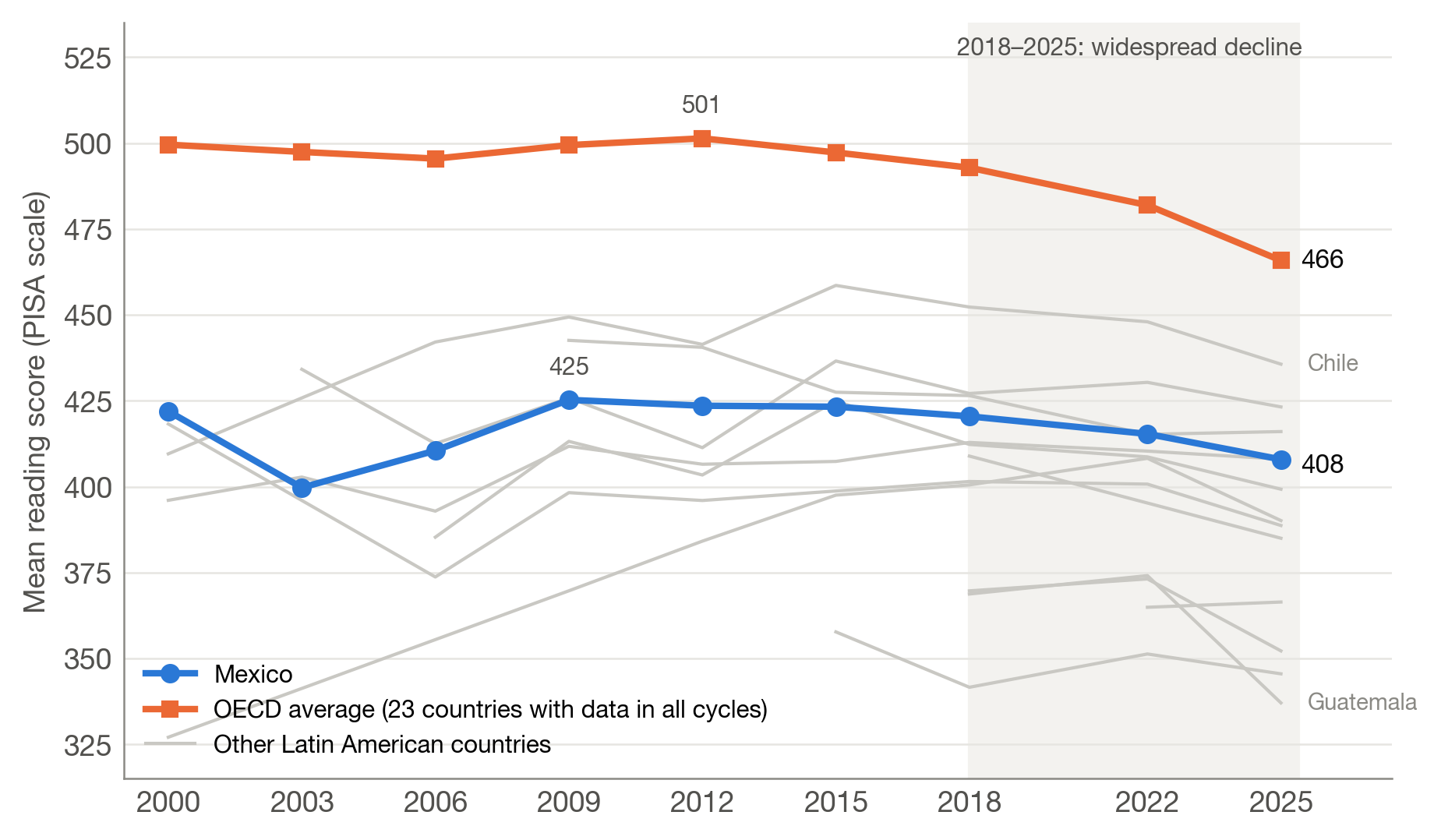
Note. The OECD average refers to the 23 countries with comparable data in all cycles. Gray lines show the other Latin American countries participating in 2025. Elaboration based on Table I.B1.2a.37 (OECD, 2026b).
The second process is the expansion of enrollment coverage. In 2025, the PISA sample represented 69% of Mexican 15-year-olds (Coverage Index 3), compared with 66% in 2018; the rest were not enrolled in lower or upper secondary education or had been held back in lower grades (OECD, 2026b). When schooling expands to previously excluded populations, averages can fall even if the competencies of comparable students do not change, and the OECD includes Mexico among the countries where part of the decline is likely linked to the integration of youth from marginalized populations (OECD, 2026b, pp. 104–106). This composition effect, however, does not explain the whole phenomenon: among the top-performing 25% of the full age cohort—a group whose composition is practically unaffected by the expansion—Mexican reading declined by 11.1 points per decade (SE = 5.5) and mathematics by 23.0 points (SE = 5.2), whereas science remained stable (OECD, 2026b). The conclusion is twofold: Mexican schools now serve more young people than a decade ago and, at the same time, the reading competence of their best students is eroding. Other countries in the region experienced much larger coverage expansions—from 56% to 80% in Paraguay and from 61% to 84% in Ecuador between 2018 and 2025—which calls for particular caution in interpreting their declines.
Figure 2
Reading Performance and Share of Students Below Level 2 in Latin America, PISA 2025
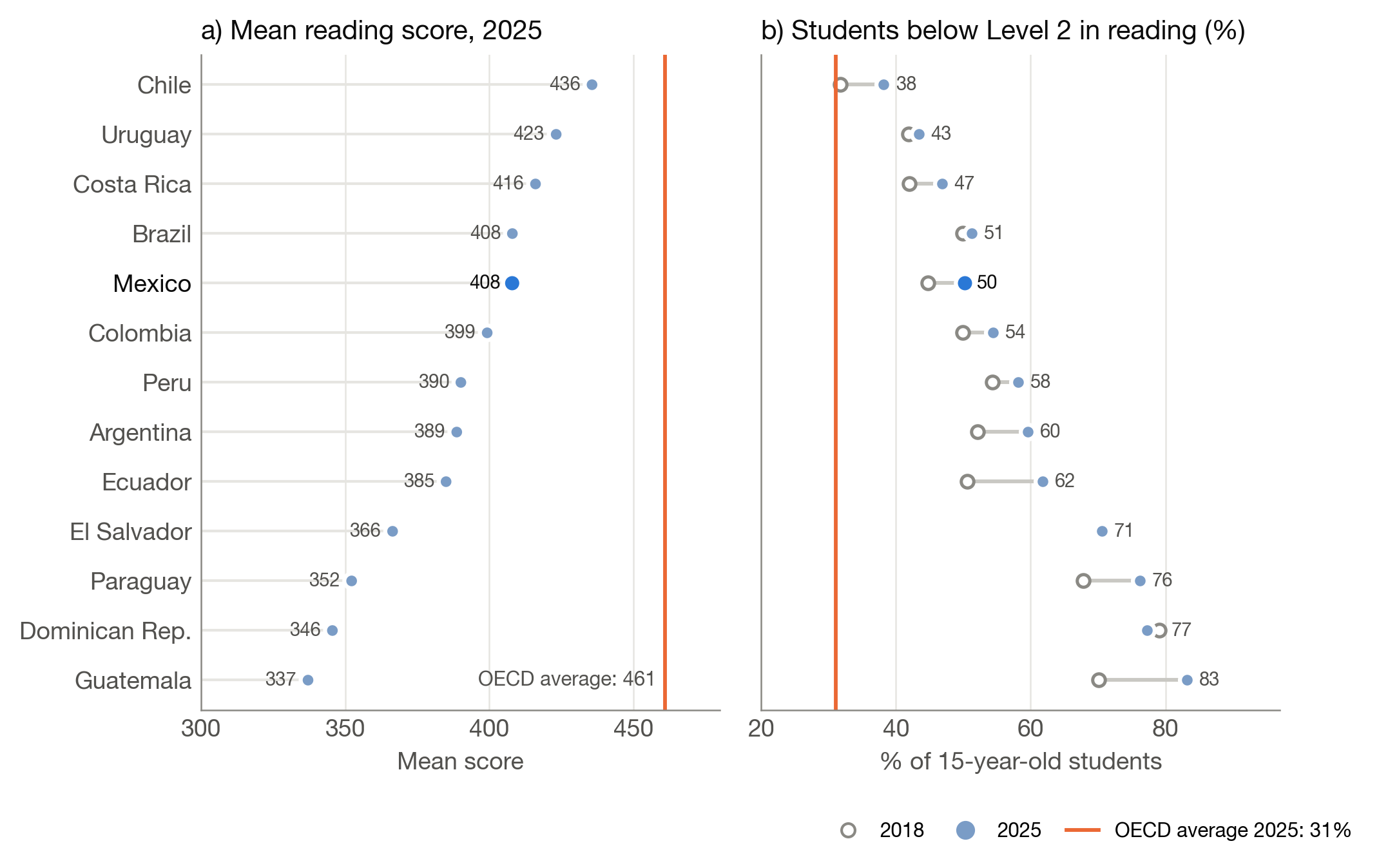
Note. Panel a: mean reading score in 2025. Panel b: percentage of students below Level 2 (baseline proficiency); open circles indicate 2018 (2017 for Ecuador, Guatemala and Paraguay, which took part in PISA for Development). El Salvador did not participate in 2018. Vertical lines show the OECD average. Elaboration based on Tables I.B1.2a.2, I.B1.2a.11 and I.B1.2a.34 (OECD, 2026b).
The problem is not limited to adolescence. Comparing the cohort assessed by PISA in 2009 with people born in the same years and assessed in the 2023 Survey of Adult Skills, the OECD found that in Chile—the only Latin American country included in that analysis—more than 10% of young adults around age 30 had scores that would have placed them in the bottom decile of 15-year-olds in 2009, suggesting that reading competence deteriorated after school among those who started from low levels (OECD, 2024, 2026b, p. 108).
The Nature of the Decline: Attention, Fluency, and Hasty Reading
The most novel contribution of PISA 2025 is not the confirmation of the decline but the analysis of how it occurs. Because the 2025 reading tasks were the same as in 2018 and 2022, the OECD was able to track changes in the success rate of each item under controlled conditions. Between 2018 and 2022, performance fell most on units with long texts, on multiple-choice items, and on the processes of evaluating and reflecting, which require careful reading and the retention and integration of several pieces of information; locating isolated information, which can be done with a superficial but targeted reading, was the least affected (OECD, 2026b, p. 312). By 2025, differences across cognitive processes had narrowed, but text length remained a decisive driver of the decline (OECD, 2026b, p. 318).
The most telling behavioral indicator is the increase in hasty responses: incorrect answers given in less time than the fastest students who answer correctly. On average across the OECD, their share rose by more than four percentage points between 2018 and 2025, reaching about 9% (OECD, 2026b, p. 313). In Latin America, the increase was significant in every country with comparable data: from 6.1% to 16.7% in the Dominican Republic, from 4.6% to 11.7% in Uruguay, from 6.4% to 12.3% in Brazil, and from 3.1% to 5.6% in Mexico (Figure 3). In the reading-fluency test, the share of accurate readers fell by seven percentage points across the OECD, and the share of hasty readers rose from 6.6% to 11.4%, with most of the increase occurring between 2022 and 2025 (OECD, 2026b, p. 314); in Mexico, accurate readers decreased from 69.9% to 64.0% and hasty readers increased from 5.0% to 6.6%, while in Chile the latter rose from 4.5% to 12.0% (OECD, 2026b).
Figure 3
Hasty (Fast and Incorrect) Responses to PISA Reading Items, 2018 and 2025
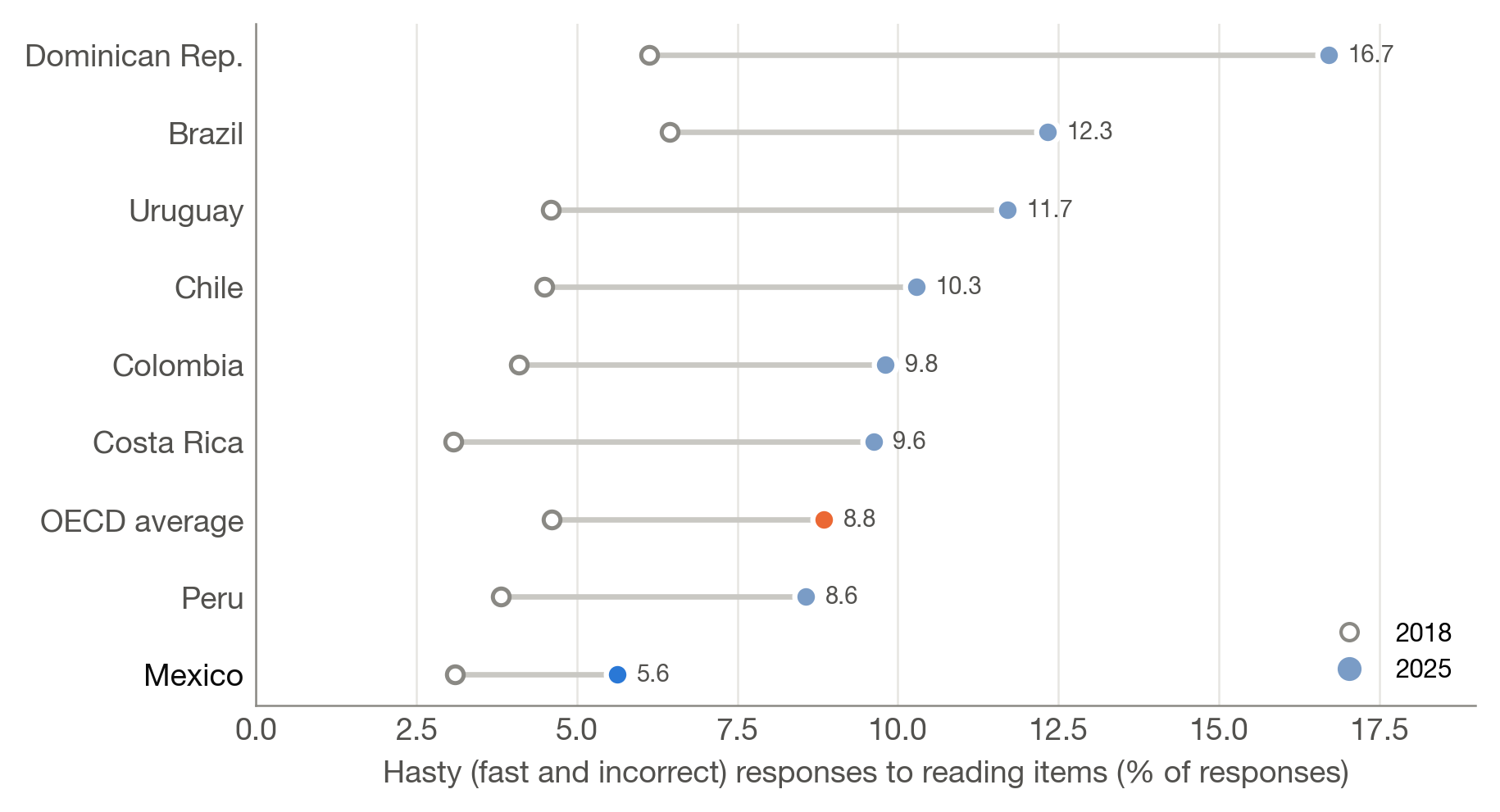
Note. Percentage of responses to trend reading items scored as incorrect and given in less time than the OECD minimum-effort threshold (1st percentile of the response time of correct respondents, or 10 seconds). Latin American countries with 2018 data are shown; all changes are statistically significant. OECD average of 35 countries. Elaboration based on Table I.A1.12 (OECD, 2026b).
The OECD examined and ruled out several methodological explanations. Fatigue during the test does not explain the trends, since declines were similar in countries with high and low fatigue effects, and the share of students who responded mechanically to the questionnaires actually decreased (OECD, 2026b, pp. 316–317). There is, however, a modest decrease in self-reported effort—half a point on a ten-point scale relative to 2018—and a cross-country association between declines in reported curiosity and declines in reading (OECD, 2026b, pp. 315–316). Moreover, the share of fourth graders absent from school at least once every other week rose from 10.7% in 2019 to 14.8% in 2023 on average across the OECD, an indication that the schooling of these cohorts was more discontinuous (OECD, 2026a, 2026b, p. 316). The OECD's reading of the evidence is clear: scores are falling also, and perhaps primarily, because of a decline in the kind of focused and sustained attention that is itself part of the reading construct PISA assesses (OECD, 2026b, pp. 315, 318).
Digital Devices and Reading: Time, Medium, and Attention
Time and Purpose of Use
On average across the OECD, 15-year-olds report using digital devices about six hours a day on weekdays and five on weekends; about 3.4 hours a day are devoted to leisure activities (OECD, 2026b, p. 226). The relationship with performance depends on purpose: limited or moderate use for learning is associated with better outcomes than no use or intensive use, whereas leisure use at school beyond one hour a day is associated with lower scores (OECD, 2026b, p. 229). Between 2022 and 2025, leisure time outside school decreased on average, but the share of students spending more than an hour a day on social media increased, while creative and information-seeking activities declined (OECD, 2026b, pp. 227–228). In Mexico, reported leisure use outside school is lower than the OECD average (1.8 hours before and after school and 2.5 hours on weekends, compared with 2.3 and 3.5), but leisure use at school is slightly higher (1.2 vs. 1.1 hours) (Table 2).
The displacement hypothesis holds that screen time reduces exposure to activities that build reading: reading extended texts, getting enough sleep, and conversing. Recent evidence supports it on several fronts. During the pandemic, children's and adolescents' screen time increased by 84 minutes a day—52%—and by 110 minutes among 12- to 18-year-olds (Madigan et al., 2022). Among young people aged 16 to 25, digital media use, especially phone use at night, is associated with shorter sleep duration and poorer sleep quality (Brautsch et al., 2023). And leisure digital reading does not substitute for print: a meta-analysis with 469,564 participants found a very small association between leisure digital reading habits and comprehension (r = .055), in contrast with the moderate effects of print reading, and the association is even negative in primary and middle school (Altamura et al., 2025).
In early childhood, displacement takes the form of reduced verbal interaction. In a Japanese cohort of 7,097 mother–child dyads, four or more hours of daily screen time at age 1 was associated with odds of communication delay 4.78 times higher at age 2 and 2.68 times higher at age 4 (Takahashi et al., 2023). Using automated recordings of the home language environment, an Australian study showed that, at 36 months, each additional minute of screen time was associated with 6.6 fewer adult words, 4.9 fewer child vocalizations, and 1.1 fewer conversational turns, a phenomenon known as technoference (Brushe et al., 2024). Context nonetheless modulates the effects: program viewing and background television are negatively associated with cognitive outcomes, whereas co-use with an adult is positively associated with them (r = 0.14) (Mallawaarachchi et al., 2024). An umbrella review of 102 meta-analyses confirmed this ambivalence: screen use is negatively associated with literacy (r = −0.14), but the association becomes positive when parents watch with their children (r = 0.15), and 95 of the meta-analyses had a moderate or high risk of bias (Sanders et al., 2024).
The Medium: The Screen Inferiority Effect
Reading on screen is not equivalent to reading on paper. A multilevel meta-analysis of handheld devices found a small but consistent advantage for print (g = −0.113 in 38 between-participant studies and g = −0.103 in 21 within-participant studies), more pronounced among undergraduates than among school students (Salmerón et al., 2024). For children aged 1 to 8, digital books that merely digitize the text produce lower comprehension than print books, and adult mediation during print reading is more effective than multimedia enhancements, although story-congruent enhancements can reverse that disadvantage (Furenes et al., 2021). The proposed mechanisms concern depth of processing: under time pressure, on-screen readers mind-wander more and understand less, supporting the hypothesis of shallower processing (Delgado & Salmerón, 2021), and reading on a smartphone is accompanied by fewer sighs, prefrontal overactivity, and lower comprehension, although this neurophysiological evidence comes from a small adult sample (Honma et al., 2022). Taken individually, these effects are modest; their relevance lies in the fact that they accumulate over thousands of hours of reading and that they match the PISA 2025 pattern: more hasty responses and greater difficulty with long texts.
Attention: Classroom Distraction and the Mere-Presence Effect
In PISA 2025, 28% of OECD students reported that classmates get distracted by digital devices in most or every science lesson; the share is higher in disadvantaged schools (31%) than in advantaged ones (26%), and distraction is associated with lower performance in more than two thirds of systems (OECD, 2026b, pp. 230–231). In Mexico, the figure rises to 37.3%, and in Uruguay and Argentina it exceeds 55% (Table 2). An important nuance is that, in Mexico, distraction is not associated with performance once socioeconomic status is accounted for (+0.2 points; SE = 1.8), unlike the OECD average (−10.9 points) (OECD, 2026b), which suggests that other determinants weigh more heavily in contexts of widespread low performance.
Experimental research provides mechanisms, albeit with more modest effects than is often assumed. A meta-analysis of 22 experimental studies and 43 effects found a small overall negative effect of smartphone use and mere presence (g = −0.14), significant for memory (g = −0.23) but not for attention or general cognitive performance, with considerable heterogeneity (Böttger et al., 2023). Among university students, problematic phone use is negatively associated with learning (r = −0.12; N = 147,943) (Sunday et al., 2021). These results are consistent with the OECD's interpretation that distraction reduces effective learning time and imposes the cognitive costs of divided attention (OECD, 2026b, p. 231).
Table 2
Digital Device Use, Distraction, School Policies, and AI Use in Latin America, PISA 2025
| Country | Leisure use at school (h/day) | Leisure use outside school, weekdays (h/day) | Frequent digital distraction (%) | Schools banning phones, 2022 → 2025 (%) | Summarizes texts with AI at least weekly (%) | Never used AI for schoolwork (%) |
|---|---|---|---|---|---|---|
| Uruguay | 1.4 | 2.3 | 56.9 | 6 → 14* | 42.7 | 7.2 |
| Argentina | 1.6 | 3.0 | 55.4 | 30 → 37 | 40.6 | 9.6 |
| Chile | 1.1 | 1.8 | 47.9 | 34 → 58* | 33.0 | 6.5 |
| Paraguay | 1.8 | 1.9 | 37.8 | 30 → 43* | 34.6 | 10.5 |
| Costa Rica | 1.3 | 2.0 | 37.5 | 13 → 23* | 37.0 | 9.7 |
| Mexico | 1.2 | 1.8 | 37.3 | 22 → 27 | 33.7 | 8.3 |
| Colombia | 1.3 | 1.8 | 35.8 | 31 → 37 | 39.5 | 6.3 |
| Dominican Republic | 1.8 | 2.0 | 32.4 | 55 → 77* | 40.1 | 9.4 |
| Ecuador | 1.2 | 1.8 | 28.3 | — → 86 | 38.2 | 6.8 |
| Guatemala | 0.9 | 1.4 | 27.0 | 66 → 50* | 39.1 | 11.4 |
| Brazil | 1.0 | 2.5 | 24.9 | 37 → 81* | 31.4 | 11.3 |
| Peru | 1.0 | 1.4 | 24.4 | 64 → 86* | 39.5 | 8.0 |
| El Salvador | 1.2 | 1.6 | 23.0 | 45 → 71* | 28.2 | 10.9 |
| OECD average | 1.1 | 2.3 | 28.4 | 34 → 49* | 29.7 | 13.7 |
Note. Countries ordered by digital distraction. Frequent digital distraction: students reporting that classmates get distracted by devices in most or every science lesson. Ban: students in schools whose principal reported that phones are not allowed on the premises; * significant change between 2022 and 2025. Elaboration based on Tables I.B1.4.21, I.B1.4.43, I.B1.4.47, I.B1.4.48, I.B1.4.53 and I.B1.4.55 (OECD, 2026b).
Counterweights: What the Evidence Does Not Allow Us to Claim
A rigorous review requires acknowledging the limits of this literature. Most studies on screen time are correlational and rely on self-reports, and their effects tend to be small and heterogeneous (Sanders et al., 2024); moreover, the relationship may be bidirectional: in adolescence, lower life satisfaction also predicts greater subsequent social media use (Orben et al., 2022). In a U.S. cohort of 9,855 children, time spent gaming predicted increases in intelligence two years later, after accounting for genetic and socioeconomic differences (Sauce et al., 2022). The thesis that smartphones and social media alone caused the adolescent mental health crisis has been challenged for lack of sufficient causal evidence (Odgers, 2024). And although there are signs of a reversal of the Flynn effect in U.S. adult samples (Dworak et al., 2023), its causes are not established. The prudent conclusion is that devices matter less because of the amount of time spent than because of the purpose, the context, and the attentional regime they shape.
Generative Artificial Intelligence and Reading Cognition
Massive and Unequal Adoption
PISA 2025 provides the first internationally comparable measure of the school use of AI chatbots. Only 14% of OECD students had never used them for schoolwork, and the most frequent purpose was "to help me learn," followed by researching a new topic, drafting written assignments, and summarizing texts they had to read (OECD, 2026b, pp. 236–237). Mexico is above that average: only 8.3% had not used AI for school purposes, 33.7% use it at least weekly to summarize assigned texts—compared with 29.7% across the OECD—and 34.8% to draft written assignments (Figure 4). In the region, weekly use to summarize readings ranges from 28% in El Salvador to 43% in Uruguay. Nonusers tend to come from disadvantaged households, whereas frequent use is concentrated among advantaged students (OECD, 2026b, p. 241). Adoption begins before age 15: in Brazil, 65% of internet users aged 9 to 17 used generative AI in 2025, most of them for school tasks or studying (Núcleo de Informação e Coordenação do Ponto BR [NIC.br], 2026), and in Argentina 58% of 9- to 17-year-olds had used ChatGPT at least once, with a marked socioeconomic gradient—42% in low-income households versus 75% in high-income ones (UNICEF Argentina & UNESCO, 2025). Mexico does not yet have official statistics on children's and adolescents' use of generative AI.
Figure 4
Weekly Use of AI Chatbots to Summarize Readings and Draft Assignments in Latin America, PISA 2025
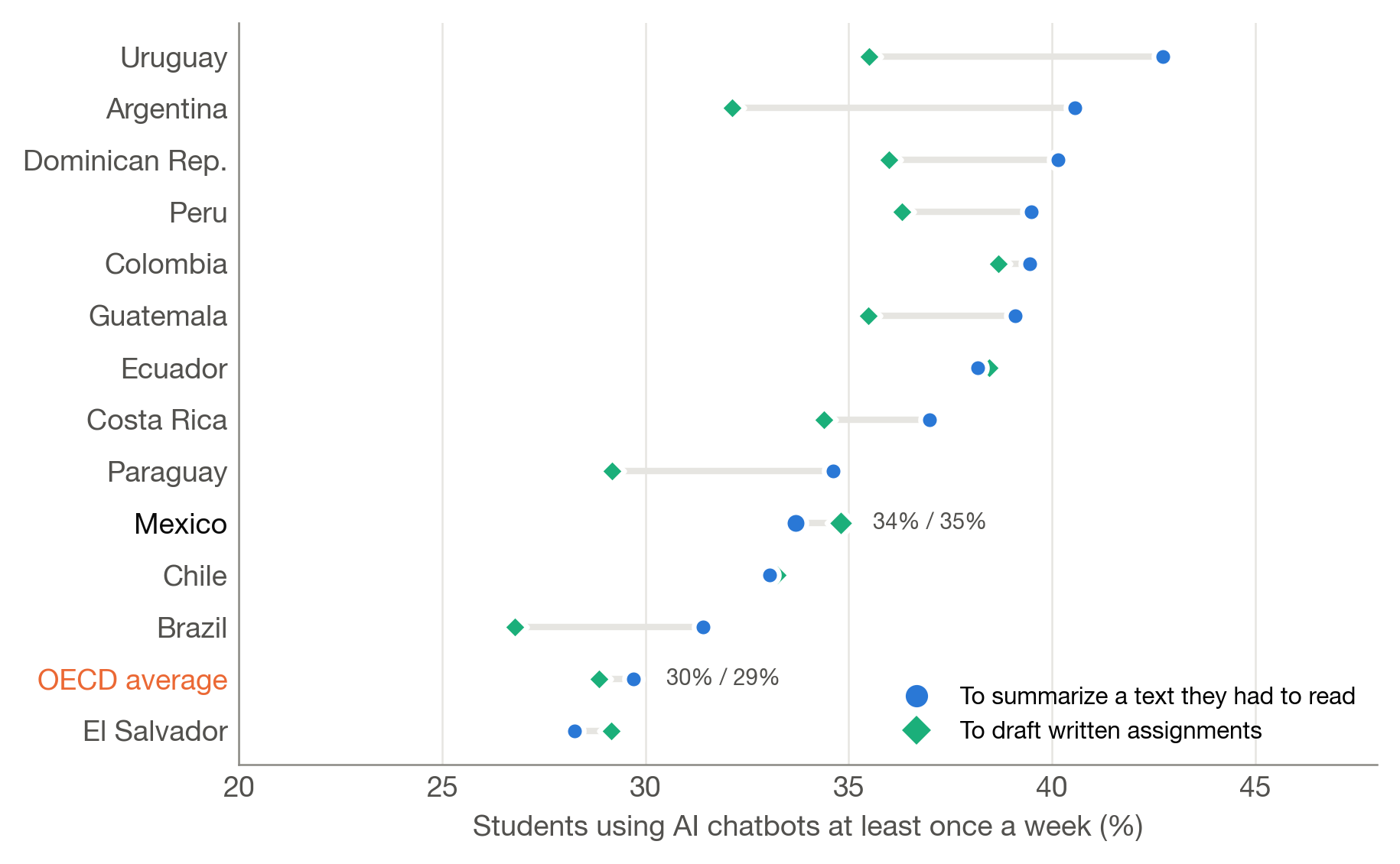
Note. Percentage of students who reported using AI chatbots (e.g. ChatGPT) for schoolwork once or twice a week, or every day or almost every day. Figures next to Mexico and the OECD average refer to “to summarise a text I had to read” and “to draft texts for writing assignments”, respectively. Elaboration based on Table I.B1.4.53 (OECD, 2026b).
Associations With Performance
In PISA 2025, students who do not use AI for specific tasks—summarizing, drafting, or researching—outperform those who do; among users, moderate users score higher than occasional and intensive users (OECD, 2026b, pp. 238–239). The OECD cautions that these relationships do not imply a negative effect of AI and may reflect who adopts it and how. The same inverted-U pattern is observed in Mexico: students who summarize texts with AI every day score 407 points in science, compared with 418 for those who never do and 424–426 for moderate users (OECD, 2026b). Furthermore, when frequent AI use is combined with school opportunities to evaluate the quality of the information it generates, performance is slightly higher, but these opportunities are less common for disadvantaged students, foreshadowing a new divide (OECD, 2026b, p. 240).
Experimental Evidence: AI as a Crutch
Experimental studies allow a closer approximation to causality. In a field experiment with nearly a thousand high-school students, access to GPT-4 improved performance during practice (by 48% with a standard interface and by 127% with a tutor designed with pedagogical safeguards), but once the tool was removed, students who had used the standard interface obtained grades 17% lower than those who never had access; the authors show that students used AI as a "crutch" and that the tutor's safeguards largely mitigated this effect (Bastani et al., 2025). In a trial with 117 university students, ChatGPT improved the score of a written essay but not knowledge gain or transfer, and it altered self-regulated learning processes, a pattern the authors termed "metacognitive laziness" (Fan et al., 2025). Compared with a conventional search engine, using a language model reduced the cognitive load of 91 university students but produced lower-quality argumentation (Stadler et al., 2024). These findings converge with research on cognitive offloading: externalizing information improves immediate performance but impairs later memory unless there is an explicit learning goal (Grinschgl et al., 2021).
Correlational evidence points in the same direction, with the limitations inherent to its design. Among 666 participants, frequent use of AI tools was associated with lower critical thinking, a relationship mediated by cognitive offloading and stronger among younger participants (Gerlich, 2025); among 319 knowledge workers, greater confidence in generative AI was associated with less critical thinking (Lee et al., 2025); and a systematic review linked overreliance on dialogue systems with adverse effects on decision-making and analytical reasoning (Zhai et al., 2024). An electroencephalography study, not yet peer reviewed and with only 54 adult participants, reported lower neural connectivity and lower ownership of the texts among those who wrote with the help of a language model (Kosmyna et al., 2025); its results should be considered preliminary.
Supportive Evidence: AI as Scaffolding
The same technology produces opposite effects depending on its pedagogical design. In a randomized trial with university physics students, an AI tutor built on the same pedagogical principles as the in-person class achieved more learning in less time than active-learning instruction (Kestin et al., 2025). In Nigeria, a six-week tutoring program with a language model improved senior secondary students' outcomes by 0.31 standard deviations, and English outcomes by 0.23, an effect equivalent to 1.5 to 2 years of business-as-usual schooling and comparable to the most cost-effective interventions known (De Simone et al., 2025). A meta-analysis of 69 experimental publications found improvements in academic performance and in higher-order thinking propensities, together with a reduction in mental effort (Deng et al., 2025); however, better performance while using the tool does not guarantee durable learning—as the experiment by Bastani et al. (2025) showed—and another widely cited meta-analysis in the same field was retracted in April 2026, illustrating the fragility of this emerging literature.
Synthesis: Substitution Versus Augmentation
The available evidence supports a distinction that is central for reading: generative AI can either substitute for the effort of reading or scaffold it. When it summarizes a text the student was supposed to read, it saves precisely the cognitive work—sustained attention, inference, integration—that builds comprehension; when it asks questions, gives feedback, and demands explanations, it can extend that work (Bastani et al., 2025; Yan et al., 2024). The fact that one in three Mexican students uses AI weekly to summarize their readings turns this distinction into a matter of education policy and not merely of instructional preference.
The Latin American Evidence: The Ambivalence of Technology
Research conducted in the region cautions against a one-directional reading of the problem. During school closures, the lack of connectivity and computers was associated with lower learning: in Xalapa, a digital divide index correlated with reading results (r = .16), and three in five children had a high digital divide, since although about 70% had internet access, only a quarter had access to a computer (Hevia & Vergara-Lope, 2022). In Goiás, Brazil, a randomized trial with 18,256 high-school students showed that text messages aimed at strengthening socioemotional skills during remote schooling prevented 24% of learning losses in Portuguese (Lichand et al., 2024). In PISA 2025, shortages of digital resources in schools are associated with lower performance, although the relationship is largely explained by socioeconomic status (OECD, 2026b, p. 224). The global expert panel that synthesizes cost-effectiveness evidence for low- and middle-income countries classifies investment in hardware—laptops or tablets—alone as a bad buy, and the use of mobile phones to support learning as a promising strategy with limited evidence (Global Education Evidence Advisory Panel [GEEAP], 2023). At the same time, descriptive data from the region document the competition between screens and reading: in Argentina, 66.2% of sixth graders used social media every day in the week before the 2025 national assessment, compared with 12.5% who read books or comics daily, and one in five reported having no books at home (Ministerio de Capital Humano, 2026); in Chile, 29% of children and adolescents report difficulty concentrating on their studies because of the time they spend on their phones (Claro et al., 2026). Technology, in sum, is neither the problem nor the solution in itself: it produces effects of opposite sign depending on whether it displaces, distracts from, or substitutes for reading, or whether it structures and extends it.
School Device Policies: What We Know
Restrictions on phone use in schools spread rapidly. Across the OECD, the share of students enrolled in schools that do not allow cell phones on the premises rose from 34% in 2022 to about half in 2025, and schools tended to combine bans with subject-specific pedagogical guidelines (OECD, 2026b, p. 234). After accounting for socioeconomic status, distraction is lower in schools with bans (27%) than in those with guidelines only (29%) or no policy at all (32%). However, changes in the prevalence of bans between 2022 and 2025 are not associated, at the system level, with changes in science or reading performance (OECD, 2026b, p. 235).
In Latin America, systems with a higher prevalence of bans tend to report less digital distraction (r = −0.70 across the thirteen countries; Figure 5). Brazil went from 37% to 81% of students in schools with bans, Chile from 34% to 59%, and Peru reached 86%, whereas Mexico barely moved from 22% to 27%—a nonsignificant change—and Uruguay, at 14%, has the highest distraction in the region (57%) (Table 2). This is an ecological, cross-sectional association that does not support causal inference.
Figure 5
School Phone Bans and Digital Distraction in Science Lessons in Latin America, PISA 2025
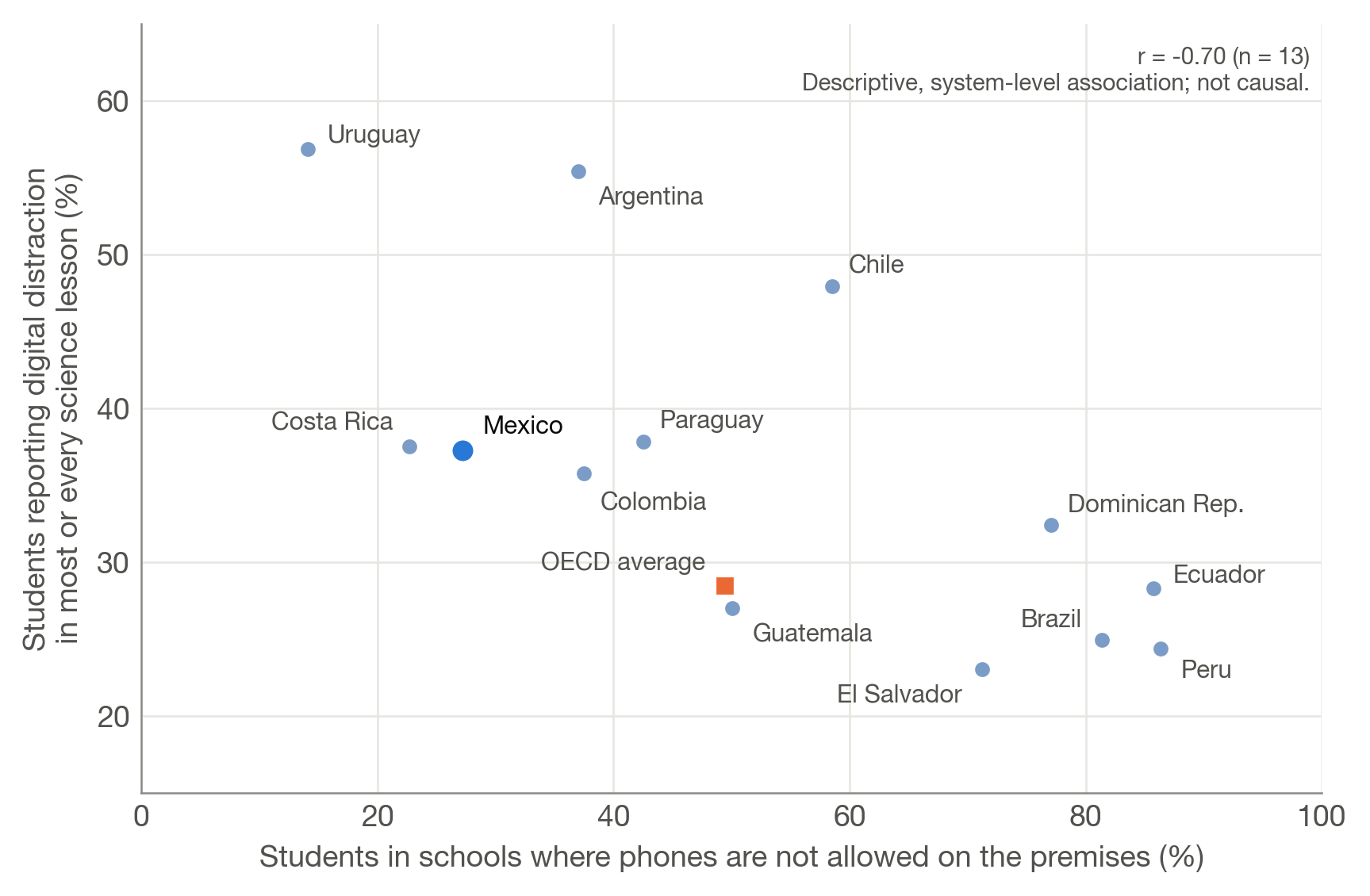
Note. Horizontal axis: percentage of students in schools whose principal reported that cell phones are not allowed on school premises. Vertical axis: percentage of students reporting that classmates get distracted by digital devices in most or every science lesson. Pearson correlation across the 13 Latin American systems: r = −0.70. This is a descriptive system-level association that does not support causal inference. Elaboration based on Tables I.B1.4.43 and I.B1.4.47 (OECD, 2026b).
The evidence on the effects of bans is less conclusive than the public debate suggests. In Spain, regional bans introduced in 2015 were associated with reductions in bullying and, in Galicia, with PISA gains equivalent to 0.6 to 0.8 years of learning in mathematics (Beneito & Vicente-Chirivella, 2022). A rapid review of five studies estimated a small overall effect (d = 0.162), clearer for social well-being than for achievement (Böttger & Zierer, 2024), and a scoping review of 22 studies noted the absence of randomized trials and the heterogeneity of definitions of a "ban" (Campbell et al., 2024). In 30 English secondary schools with 1,227 adolescents, restrictive policies reduced phone and social media use during the school day but not total use or mental well-being (Goodyear et al., 2025). The most reasonable interpretation is that restrictions reduce distraction in the classroom, but their effect on learning is modest and depends on the pedagogical practices that accompany them.
Discussion: The 4D Model of Reading Erosion
The evidence reviewed supports four claims with differing degrees of certainty. First, the decline in reading comprehension is real, broad, and unlikely to be a measurement artifact; in Mexico, moreover, it is not explained solely by the expansion of coverage. Second, its distinctive feature is the loss of the capacity to read carefully and sustain attention, visible in the rise of hasty responses and in greater difficulty with long texts. Third, the deterioration began before the pandemic and before generative AI, so neither can be its sole cause. Fourth, digital devices and AI affect reading according to the purpose, context, and pedagogical design of their use, rather than through their mere presence or total exposure time.
To integrate these findings, the 4D model is proposed (Figure 6). It identifies four mechanisms through which the digital ecosystem can erode reading comprehension and four contextual amplifiers that modulate their intensity.
Figure 6
The 4D Model of Reading-Comprehension Erosion in the Digital Age
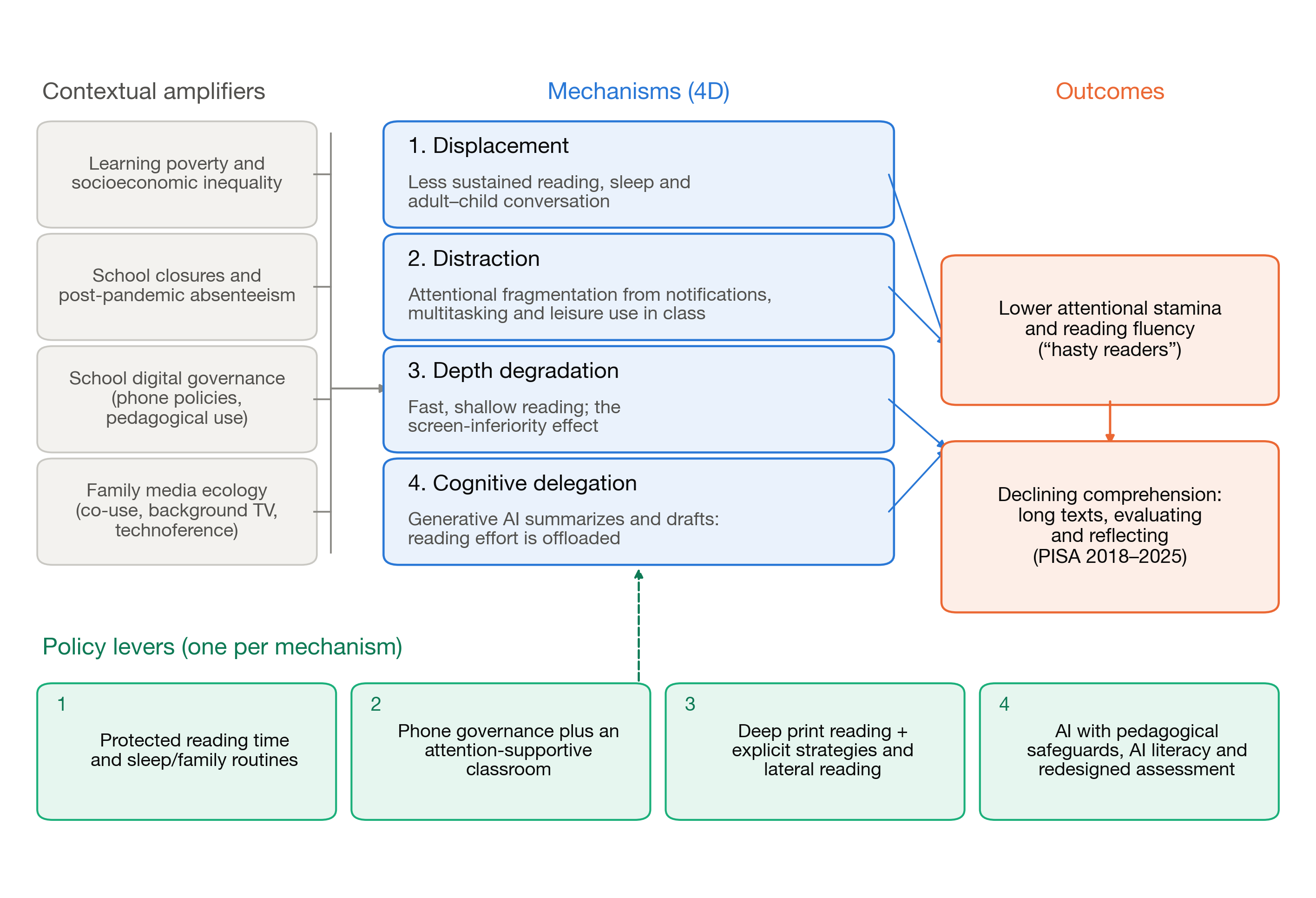
Note. Integrative conceptual model proposed in this review on the basis of the reviewed evidence. The mechanisms (D1–D4) are linked to performance outcomes and modulated by contextual amplifiers; each policy lever targets one mechanism. Arrows denote hypothesized relations, not demonstrated causality.
Four Mechanisms
Displacement (D1) refers to the substitution of activities that build reading competence—sustained reading of extended texts, sufficient sleep, and conversation between adults and children—by recreational screen use. Its support is moderate: it rests on longitudinal and cohort studies of language in early childhood (Brushe et al., 2024; Takahashi et al., 2023), on the weak association between leisure digital reading and comprehension (Altamura et al., 2025), and on the association between nighttime phone use and sleep (Brautsch et al., 2023); at the population level, the decline in adult reading in Mexico suggests an impoverishment of the home reading environment (INEGI, 2024).
Distraction (D2) refers to the fragmentation of attention by notifications, multitasking, and recreational use in class. It has clear school-level indicators (OECD, 2026b) and experimental evidence of small and heterogeneous effects—more consistent for memory than for attention (Böttger et al., 2023)—and its translation into long-term learning losses has yet to be estimated with robust causal designs in school settings (Campbell et al., 2024).
Depth degradation (D3) describes habituation to fast, fragmented, and superficial reading that transfers even to tasks demanding the opposite. It is supported by meta-analyses of the screen inferiority effect (Furenes et al., 2021; Salmerón et al., 2024), by experimental studies of shallow processing under time pressure (Delgado & Salmerón, 2021) and, at the population level, by the rise in hasty responses and the steeper decline on long texts observed in PISA (OECD, 2026b).
Cognitive delegation (D4) is the most recent mechanism and potentially the one with the greatest reach: the transfer to generative AI of the operations of summarizing, inferring, and writing, which are precisely those that schools seek to develop. Experimental evidence with high-school and university students shows that unguarded use improves immediate performance at the expense of subsequent learning (Bastani et al., 2025; Fan et al., 2025; Stadler et al., 2024), in line with research on cognitive offloading (Grinschgl et al., 2021). The share of students who use AI to summarize assigned readings turns this risk into a phenomenon at scale (OECD, 2026b).
The matrix in Appendix B summarizes the main empirical studies supporting each mechanism, with their design, sample, and level of evidence.
Four Amplifiers
The mechanisms do not operate in a vacuum. Learning poverty and inequality are the most important amplifier for Latin America: when decoding is not automatized, sustaining the reading of a long text is more costly, and digital alternatives—getting distracted, skimming, delegating—become more attractive. School closures and absenteeism reduced guided reading practice precisely in the years when these cohorts should have been consolidating fluency (Hevia et al., 2022; OECD, 2026a). School digital governance determines whether the device in the classroom functions as a tool or as a distractor (OECD, 2026b). And the family media ecology—co-use or solitary use, background television, adults' screen use during children's routines—modulates the effects from early childhood onward (Mallawaarachchi et al., 2024).
The model helps interpret one of the paradoxes of PISA 2025: that across the OECD the largest declines are concentrated in the most advantaged socioeconomic quarter (OECD, 2026b, p. 309). If displacement and delegation require access to devices and AI tools—whose frequent use is more common among advantaged students—it is to be expected that, in systems where foundational literacy is consolidated, erosion will appear first among the most exposed groups. In Latin America, by contrast, a double burden is to be expected: structural foundational literacy deficits combine with digital erosion. The Mexican case is consistent with this interpretation: digital distraction is not associated with performance once socioeconomic status is accounted for, suggesting that other determinants weigh more in a context of widespread low performance, while the decline of the top-performing 25% indicates that erosion also reaches those who have overcome the basic barriers.
Falsifiable Propositions
For the model to be useful for research, its assumptions are formulated as refutable propositions:
P1 (displacement). The association between recreational screen time and comprehension should be stronger for tasks requiring sustained reading of long texts than for information-location tasks. If longitudinal studies with time-use records find no relationship between the displacement of extended reading and later comprehension, D1 should be discarded.
P2 (distraction). Restrictions that reduce classroom distraction should produce improvements in tasks demanding sustained attention, especially where initial distraction was high. If well-implemented restrictions—such as those of Brazil, Chile, or the Agreement published in Mexico in 2026—reduce distraction but produce no change in reading comprehension after two or three years, the causal weight of D2 should be revised downward.
P3 (depth degradation). The rise in hasty responses should be associated, at the individual level, with habitual patterns of fragmented digital reading and not only with low motivation in low-stakes tests. If hasty responding is fully explained by test motivation, D3 is refuted.
P4 (delegation). Students who habitually summarize assigned readings with AI should show smaller gains in comprehension, assessed without the tool, than comparable students who use AI in tutoring mode or do not use it. If randomized trials show equal or greater gains, D4 is refuted.
P5 (amplification). The effects of D1 to D4 should be larger among students with lower reading fluency. If they prove homogeneous, the amplification hypothesis should be abandoned.
Alternative Explanations
The 4D model does not claim to explain the whole phenomenon. The school disruption associated with the pandemic and the rise in absenteeism probably carry considerable weight, and the fact that PIRLS results foreshadowed the PISA declines points to roots in early schooling (OECD, 2026b, p. 310); however, the negative reading trend began around 2012 and continued between 2022 and 2025, after schools had reopened. The cohorts assessed in 2025 were in fifth or sixth grade during the school closures, so part of their lag may be a consequence of that disruption; the fact that several national primary-level measurements show recovery while adolescent reading keeps declining is compatible both with this cohort effect and with pressures specific to digital adolescence, and distinguishing between them is a research priority. The expansion of coverage explains part of the declines in several Latin American countries, but not the decline of the top-performing segment in Mexico. The decrease in self-reported effort is modest, fatigue does not explain the trends, and demographic changes due to migration account for only a few points (OECD, 2026b, pp. 310, 315–317). Other factors—the quality of teacher preparation, curricular changes, violence, or household economic precarity—have not been evaluated in the necessary detail and should be considered in future studies. The conclusion most consistent with the evidence is multicausal: digital mechanisms operate on a foundation of structural lag and school disruption, and the two processes are likely to reinforce each other.
Strategies for Mexico and Latin America
Translating the evidence into education policy requires five principles. The first is to put foundations first: no technological regulation can make up for the absence of solid early literacy. The second is to act on mechanisms, not symbols: each intervention should target one or more of the mechanisms of the 4D model. The third is equity: gaps in access, in use, and in opportunities to learn to use AI critically reproduce preexisting inequalities (OECD, 2026b, p. 240). The fourth is to evaluate everything that is implemented, with designs that allow effects to be attributed. The fifth is to distrust single solutions: technology is neither the villain nor the savior of reading. Table 3 summarizes the strategies, the mechanism each targets, the level of supporting evidence, the responsible actors, and the monitoring indicators.
Structured Early Literacy and Teaching at the Right Level
The strongest evidence on how to improve learning in middle-income countries points to two interventions classified as the most cost-effective: structured pedagogy—lesson plans, materials, and ongoing support for teachers—and instruction targeted to students' learning level rather than their grade (Angrist et al., 2025; GEEAP, 2023). Tutoring complements these strategies: a meta-analysis of field experiments estimated an average effect of 0.29 standard deviations, larger when tutoring is delivered by teachers or paraprofessionals, in the early grades, at least three times a week, and during the school day (Nickow et al., 2024); for students at risk of dyslexia, reading interventions show significant effects that grow with dosage (Hall et al., 2023).
Latin America offers valuable experiences. In Brazil, the National Literate Child Commitment set the objective that Brazilian children be literate by the end of second grade (Decreto nº 11.556, 2023); with a comparable annual indicator, the share of literate children rose from 56% in 2023 to 66% in 2025, and the legal target is to reach at least 80% by 2030 (Instituto Nacional de Estudos e Pesquisas Educacionais Anísio Teixeira [Inep], 2026). In Ceará, the combination of municipal financing conditioned on education results and pedagogical technical assistance was associated with gains of 0.15 standard deviations in ninth grade, which doubled with technical assistance (Lautharte et al., 2021), and with a 12% increase in primary-school Portuguese scores according to a synthetic control analysis (Ponne, 2023). Chile's 2023 reactivation plan included a strategy against reading lag in grades 2 to 4, with pedagogical materials and more than 20,000 tutors (Ministerio de Educación de Chile [Mineduc], 2023), and Argentina created a national literacy plan in 2024 with explicit axes of teacher training, monitoring, and evaluation (Decreto 579/2024, 2024). Although they do not allow causal attribution, the most recent national measurements show recoveries in primary education: in Chile, the fourth-grade reading score reached the highest level in its historical series in 2024, while the tenth-grade score remained below its 2010–2012 peak (Agencia de Calidad de la Educación, 2025); in Peru, fourth-grade reading returned to pre-pandemic levels in 2024 (Oficina de Medición de la Calidad de los Aprendizajes [UMC], 2026); and in Argentina the share of sixth graders below the satisfactory level in language fell from 33.6% in 2023 to 23.1% in 2025 (Ministerio de Capital Humano, 2026). The contrast between recovery in primary school and decline in adolescence suggests that early literacy policies can bear fruit within a few years, but that adolescent reading faces additional pressures. Low-tech tutoring has also shown effects in the region: in El Salvador, phone-call tutoring combined with text messages over eight weeks improved mathematics learning by 0.23 standard deviations (Zoido et al., 2024).
For Mexico, the priority is to establish a national early literacy policy with verifiable targets, including a census-based diagnostic of fluency and comprehension at the end of second or third grade, structured materials, in-classroom support for teachers, and targeted tutoring for students who do not reach the expected levels.
Deep and Extended Reading in School Time
Since the most characteristic feature of the decline is the loss of the capacity to sustain the reading of long texts, schools must deliberately rebuild that capacity. Three evidence-based qualifications are necessary. First, unguided independent reading time is not enough: a synthesis of experimental and quasi-experimental studies conducted between 2000 and 2020 found no meaningful benefits of silent independent reading, although the quality of the studies was limited (Erbeli & Rice, 2022). Second, explicit instruction in comprehension strategies and the development of background knowledge produce substantial effects among struggling readers (g = 0.59) (Filderman et al., 2022). Third, for extended texts and study, paper retains a small but consistent advantage (Salmerón et al., 2024), and in early childhood shared and dialogic reading with an adult is more effective than digital enhancements (Furenes et al., 2021; Pillinger & Vardy, 2022). At the close of its analysis of the trends, the OECD notes that print reading remains relevant for building the stamina and agility required by today's information ecosystem (OECD, 2021, 2026b, p. 318).
The operational recommendation is to guarantee, in every grade, daily periods of guided reading of texts of increasing length—on paper when extended reading is involved—accompanied by explicit strategy instruction, class discussion, and writing about what has been read. Mexico's National Reading Strategy, centered on reading circles and reading marathons (Secretaría de Educación Pública [SEP], n.d.), can be a promotional platform, but it must be articulated with classroom instruction and subjected to evaluation.
School Governance of Devices
Restrictions on phone use have spread very rapidly: from fewer than one in four countries in 2023 to 114 education systems—58% of countries—with national bans in March 2026 (D'Addio, 2026; UNESCO, 2023a). In the region, Brazil prohibited in January 2025 the use of personal portable devices during classes, recess, and breaks throughout basic education, with pedagogical, accessibility, and health exceptions (Lei nº 15.100, 2025); an official survey of school managers reported that 92% of schools were already implementing the law and that restrictions covering all school spaces rose from 20% to 48% of schools, although the report itself cautions that effects on learning cannot yet be measured (Secretaria de Educação Básica et al., 2026). Chile published a law in February 2026 prohibiting the use of these devices in early childhood, primary, and secondary education, which mandates an evaluation of its effects in 2030 (Ley N.° 21.801, 2026). In Mexico, the Ministry of Public Education published Agreement No. 09/09/26 on September 22, 2026, which will enter into force on November 3, 2026, and restricts the use of cell phones and personal devices throughout the school day in basic education, except for scheduled educational purposes under teacher guidance, while in upper secondary education it provides for agreements with the school community (Acuerdo número 09/09/26, 2026).
The evidence reviewed suggests prudent expectations: restrictions reduce classroom distraction and may improve the school climate, but their effects on learning are, at best, modest and dependent on implementation (Böttger & Zierer, 2024; Goodyear et al., 2025; OECD, 2026b, pp. 234–235). It is therefore recommended that the implementation of the Mexican Agreement (a) combine the restriction with subject-specific pedagogical guidelines—as most OECD schools that adopted bans between 2022 and 2025 did—so that the pedagogical use of technology is not lost; (b) include teacher training in managing attention-supportive classrooms; (c) establish a baseline and an evaluation design now that take advantage of variation in implementation timing across states, with indicators of distraction, reading stamina, school climate, and well-being; and (d) avoid presenting the restriction as a sufficient solution to the reading problem.
Artificial Intelligence With Pedagogical Safeguards
The distinction between substitution and scaffolding should become a policy criterion. Five lines of action are proposed. First, follow UNESCO's recommendation not to allow independent use of generative AI before age 13 (UNESCO, 2023b). Second, in primary and lower secondary school, design reading tasks so that the processing of the text cannot be delegated: in-class reading, annotation, oral retelling, inferential questions, and handwritten responses to what has been read, together with assessment that values the process and not only the product. Third, when AI is used, prefer tutors designed to ask questions, give feedback, and demand explanations rather than to hand out answers, since these are the ones that preserve learning (Bastani et al., 2025; De Simone et al., 2025; Kestin et al., 2025). Fourth, incorporate AI literacy into the curriculum on the basis of UNESCO's competency frameworks for students and teachers (UNESCO, 2024a, 2024b) and the AI literacy framework of the OECD and the European Commission, approved in 2026 (OECD & European Commission, 2026); PISA 2025 indicates that opportunities to critically evaluate AI-generated information are associated with better outcomes but are less frequent among disadvantaged students (OECD, 2026b, p. 240). Fifth, prepare teachers to design, supervise, and assess these practices.
Critical Digital Literacy
Reading on the internet requires specific strategies. Teaching lateral reading—leaving an unfamiliar web page to check it against other sources before trusting it—significantly improved high-school students' ability to judge the credibility of digital content after six 50-minute lessons (Wineburg et al., 2022). The OECD has recommended explicitly teaching navigation and source-evaluation strategies, given that only a small minority of students can distinguish facts from opinions (OECD, 2021). These competencies should be integrated into reading instruction rather than treated as an isolated technology topic.
Early Childhood, Families, and the Home Reading Environment
Policies aimed at families should shift from counting minutes to the quality of use: favoring co-use, avoiding background television and adults' screen use during children's routines, and protecting sleep and conversation (Brushe et al., 2024; Mallawaarachchi et al., 2024). The Argentine Society of Pediatrics recommends avoiding screens before 18 months of age, except for video calls, and limiting their use after age two (García & Dias de Carvalho, 2022). In Mexico, the stimuli most often mentioned by adult readers are having had books other than textbooks at home and having seen their parents or guardians read (INEGI, 2024), which supports programs that provide books and promote shared reading in early childhood.
Measurement, Evaluation, and Accountability
Mexico cannot design or evaluate reading policies without data. It is essential to restore a stable, technically independent national learning assessment that is comparable over time and measures at least reading fluency and comprehension in the early grades of primary school, at the end of primary school, and at the end of lower secondary school; to maintain participation in PISA and return to nationally representative participation in ERCE; to publish microdata; and to monitor school attendance as an early risk indicator (OECD, 2026a). The fragility of these systems is not unique to Mexico: in September 2026, Peru rescinded its national learning assessment planned for that year and rescheduled it for 2027 (Resolución Ministerial N.° 550-2026-MINEDU, 2026). The 2026 Agreement on devices also offers an exceptional opportunity for rigorous evaluation that should not be missed.
Regulating Children's Digital Environment
Finally, responsibility cannot rest solely with schools and families. In 2025, Brazil approved the Digital Statute of the Child and Adolescent, which requires reliable age-verification mechanisms—self-declaration is not accepted—for inappropriate content, with fines of up to 10% of revenue in the country (Lei nº 15.211, 2025), and Australia established a minimum age of 16 for holding social media accounts (Online Safety Amendment Act, 2024). In Mexico there are legislative initiatives on the subject, but none has been approved (Huerta Romero, 2026). An evidence-based deliberation on age-appropriate design, age assurance, and limits on features designed to capture attention, with evaluation of their effects, is recommended.
Table 3
Roadmap of Strategies for Mexico and Latin America
| Strategy | Mechanism | Evidence | Actors | Horizon | Monitoring indicators |
|---|---|---|---|---|---|
| Structured early literacy, teaching at the right level and tutoring | Amplifier; D3 | A | Ministry, state authorities, schools | 1–4 years | % literate at end of grade 2; fluency; % below minimum level |
| Daily guided reading of extended texts, explicit strategy instruction and print for extended reading | D1; D3 | A–B | Teachers, principals, school libraries | 1–2 years | Daily minutes of guided reading; text length; inferential comprehension |
| School device governance with pedagogical guidelines, teacher training and evaluation | D2 | B-C | Ministry, state authorities, schools | Immediate; 3-year evaluation | Reported distraction; bullying; reading stamina; wellbeing |
| AI with pedagogical safeguards, AI literacy and redesigned assessment | D4 | B; D | Ministry, teacher educators, developers | 1–3 years | % summarizing assigned readings with AI; opportunities to evaluate AI-generated information; comprehension without AI support |
| Critical digital literacy (lateral reading, source evaluation) | D2; D3 | B | Teachers, curriculum authorities | 1–2 years | Ability to judge credibility; distinguishing facts from opinions |
| Early childhood and families: co-use, dialogic reading, sleep and books at home | D1 | B | Health, early education, child-protection systems, families | 2–5 years | Weekly shared reading; books at home; screen exposure before age 2 |
| Measurement and evaluation: stable national assessment, PISA and ERCE participation, microdata and attendance | Cross-cutting | — | Congress, Ministry, independent technical body | 2–3 years | Comparable reading series; national ERCE participation; microdata release |
| Regulation of the digital environment: age-appropriate design and age assurance | D1; D2 | D | Congress, regulators, platforms | 3–5 years | Enacted and evaluated rules; exposure indicators |
Note. Evidence: levels as defined in the Method section; “—” denotes an enabling measure not evaluated by its direct effect on learning. Mechanisms: D1 = displacement; D2 = distraction; D3 = depth degradation; D4 = cognitive delegation.
Limitations and Research Agenda
This state-of-the-art review has limitations that should be made explicit. Because of its critical narrative design, the selection of studies—although supported by structured and verified searches—does not have the exhaustiveness of a systematic review, and no original pooled effects were estimated. Most of the experimental evidence on devices and AI comes from high-income countries and, in the case of generative AI, from university students and short interventions; its transfer to Latin American children should be treated with caution. PISA data are cross-sectional, the indicators of device and AI use are self-reported, and cross-country associations are ecological; therefore, none of the relationships described on the basis of PISA should be interpreted as causal. The analysis relied on the tables published by the OECD rather than on a reanalysis of microdata. Some regional figures come from simulations—such as the learning poverty projections—or from chart data in official reports, and this has been noted. Finally, the speed at which AI tools evolve means that part of the evidence may soon become outdated.
The research agenda that emerges from this review is broad. Five priorities stand out for Mexico and Latin America. First, multilevel analysis of the PISA 2025 microdata, including process data—response times and navigation patterns—to test propositions P1 to P5 with individual-level information. Second, the incorporation of the ERCE 2025 results, expected toward the end of 2026 (Fondo para la Excelencia de la Educación y la Investigación [FEEI], 2025), and of the PISA 2025 assessment of learning in the digital world, which the OECD will publish in Volume III of the report (OECD, 2026b, p. 49), which will make it possible to examine primary education and the capacity to learn effectively in digital environments. Third, rigorous evaluation of the phone restrictions recently adopted in Brazil, Chile, and Mexico, which constitute highly valuable natural experiments if baselines are collected and implementation timing is documented. Fourth, randomized trials of AI tutors with pedagogical safeguards, in Spanish and with basic-education students, that measure reading comprehension without the tool and its persistence over time. Fifth, Latin American longitudinal cohorts linking early screen exposure, the home reading environment, and the development of fluency and comprehension. Reading will again be the major domain of PISA in 2029 (OECD, 2026b, p. 318); the region has three years to reach that assessment with evidence-based policies and with information systems capable of evaluating them.
Conclusions
The PISA 2025 results confirm that the world faces a deep and widespread decline in the reading comprehension of its adolescents and, above all, they specify its nature: what is eroding is the capacity to read carefully, to sustain attention on long texts, and to evaluate and integrate what is read. In Mexico and Latin America, this erosion is superimposed on a historical lag in foundational literacy, on the world's longest school closures and, in the Mexican case, on the weakening of national assessment capacities. Half of Mexican 15-year-old students today do not reach baseline reading proficiency, and the decline also reaches the country's best students.
The evidence reviewed does not support the thesis that smartphones or generative AI are, by themselves, the cause of the problem, but it does identify plausible and, in several cases, well-documented mechanisms through which the digital ecosystem can aggravate it: the displacement of extended reading, sleep, and conversation; classroom distraction; the degradation of deep reading; and the delegation to AI of the cognitive effort that reading demands. The proposed 4D model organizes these mechanisms, links them to the contextual amplifiers characteristic of the region, and translates them into propositions that research can test.
The policy response should not be symbolic. Restricting phones in schools, as Brazil, Chile, and Mexico have just done, can reduce distraction, but it will not teach reading to those who have not mastered early reading, nor will it by itself rebuild the capacity to sustain attention on a complex text. The strategies with the strongest support—structured early literacy, teaching at the right level, tutoring, guided reading of extended texts, explicit instruction in comprehension strategies and in critical reading in digital environments, AI with pedagogical safeguards, and work with families from early childhood—require time, sustained investment and, above all, measurement systems capable of showing whether they work. If the 2025 data teach anything, it is that deep reading is not a relic of another era but a capacity that must be protected and deliberately taught in the age of artificial intelligence.
Declarations
Conflict of interest. There are no conflicts of interest.
Funding. This work received no specific grant from any funding agency in the public, commercial, or not-for-profit sectors.
Ethics approval. Not applicable: the study analyzes published documents and publicly available aggregate data and involves no human participants.
Data availability. The PISA 2025 data come from the official data workbooks (StatLinks) of Volume I published by the OECD, which are publicly available; the search strings and the counts per database are reported in Appendix A.
Declaration of generative AI use. Generative artificial intelligence tools—Claude (Anthropic) and the image generator integrated into Codex (OpenAI)—were used in preparing this work to support bibliographic search and verification, processing of the official tables, preliminary drafting, translation, and the graphical abstract, an illustration that contains no data. All content was reviewed before publication: every DOI was checked against Crossref, retractions and corrections were screened, and every figure was checked against the original document.
References
Acuerdo número 06/08/23 por el que se modifica el diverso número 14/08/22 por el que se establece el Plan de Estudio para la educación preescolar, primaria y secundaria [Agreement 06/08/23 amending Agreement 14/08/22 establishing the curriculum for preschool, primary and lower secondary education]. (2023, August 15). Diario Oficial de la Federación. https://dof.gob.mx/nota_detalle.php?codigo=5698663&fecha=15/08/2023
Acuerdo número 09/09/26 para garantizar los derechos de niñas, niños, adolescentes y jóvenes en la interacción, uso responsable y seguro de los dispositivos digitales personales, así como de tecnologías de aprendizaje en las escuelas públicas y particulares del Sistema Educativo Nacional [Agreement 09/09/26 to guarantee the rights of children, adolescents and young people in the interaction with, and responsible and safe use of, personal digital devices and learning technologies in public and private schools of the National Education System]. (2026, September 22). Diario Oficial de la Federación. https://dof.gob.mx/nota_detalle.php?codigo=5799247&fecha=22/09/2026
Acuerdo número 14/08/22 por el que se establece el Plan de Estudio para la educación preescolar, primaria y secundaria [Agreement 14/08/22 establishing the curriculum for preschool, primary and lower secondary education]. (2022, August 19). Diario Oficial de la Federación. https://dof.gob.mx/nota_detalle.php?codigo=5661845&fecha=19/08/2022
Agencia de Calidad de la Educación. (2025, March 6). Resultados Simce 2024 revelan histórico avance en 4° básico [Simce 2024 results reveal historic progress in 4th grade] [Press release]. https://www.agenciaeducacion.cl/resultados-simce-2024-revelan-historico-avance-en-4basico/
Altamura, L., Vargas, C., & Salmerón, L. (2025). Do new forms of reading pay off? A meta-analysis on the relationship between leisure digital reading habits and text comprehension. Review of Educational Research, 95(1), 53–88. https://doi.org/10.3102/00346543231216463
Angrist, N., Evans, D. K., Filmer, D., Glennerster, R., Rogers, H., & Sabarwal, S. (2025). How to improve education outcomes most efficiently? A review of the evidence using a unified metric. Journal of Development Economics, 172, Article 103382. https://doi.org/10.1016/j.jdeveco.2024.103382
Arias Ortiz, E., Bos, M. S., Chen Peraza, J., Giambruno, C., Levin, V., Oubiña, V., Pineda, J. A., & Zoido, P. (2024). Learning can't wait: Lessons for Latin America and the Caribbean from PISA 2022. Inter-American Development Bank; World Bank. https://doi.org/10.1596/41144
Bastani, H., Bastani, O., Sungu, A., Ge, H., Kabakcı, Ö., & Mariman, R. (2025). Generative AI without guardrails can harm learning: Evidence from high school mathematics. Proceedings of the National Academy of Sciences, 122(26), Article e2422633122. https://doi.org/10.1073/pnas.2422633122
Beneito, P., & Vicente-Chirivella, Ó. (2022). Banning mobile phones in schools: Evidence from regional-level policies in Spain. Applied Economic Analysis, 30(90), 153–175. https://doi.org/10.1108/AEA-05-2021-0112
Betthäuser, B. A., Bach-Mortensen, A. M., & Engzell, P. (2023). A systematic review and meta-analysis of the evidence on learning during the COVID-19 pandemic. Nature Human Behaviour, 7(3), 375–385. https://doi.org/10.1038/s41562-022-01506-4
Böttger, T., Poschik, M., & Zierer, K. (2023). Does the brain drain effect really exist? A meta-analysis. Behavioral Sciences, 13(9), Article 751. https://doi.org/10.3390/bs13090751
Böttger, T., & Zierer, K. (2024). To ban or not to ban? A rapid review on the impact of smartphone bans in Schools on social well-being and academic performance. Education Sciences, 14(8), Article 906. https://doi.org/10.3390/educsci14080906
Brautsch, L. A., Lund, L., Andersen, M. M., Jennum, P. J., Folker, A. P., & Andersen, S. (2023). Digital media use and sleep in late adolescence and young adulthood: A systematic review. Sleep Medicine Reviews, 68, Article 101742. https://doi.org/10.1016/j.smrv.2022.101742
Brushe, M. E., Haag, D. G., Melhuish, E. C., Reilly, S., & Gregory, T. (2024). Screen time and parent-child talk when children are aged 12 to 36 months. JAMA Pediatrics, 178(4), 369–375. https://doi.org/10.1001/jamapediatrics.2023.6790
Campbell, M., Edwards, E. J., Pennell, D., Poed, S., Lister, V., Gillett-Swan, J., Kelly, A., Zec, D., & Nguyen, T.-A. (2024). Evidence for and against banning mobile phones in schools: A scoping review. Journal of Psychologists and Counsellors in Schools, 34(3), 242–265. https://doi.org/10.1177/20556365241270394
Claro, M., Cabello, P., & Castro Grau, C. (2026). Experiencia digital en la niñez y adolescencia en América Latina: Argentina, Bolivia (Estado Plurinacional de), Brasil, Chile, Costa Rica y Uruguay [Digital experience in childhood and adolescence in Latin America: Argentina, Bolivia (Plurinational State of), Brazil, Chile, Costa Rica and Uruguay] (Project Documents LC/TS.2026/45). Economic Commission for Latin America and the Caribbean. https://hdl.handle.net/11362/90132
Comisión Nacional para la Mejora Continua de la Educación. (2023). Evaluación diagnóstica del aprendizaje de las y los alumnos de educación básica 2022-2023: Informe ejecutivo [Diagnostic assessment of the learning of basic-education students 2022-2023: Executive report]. https://web.archive.org/web/20241209050042/https://www.mejoredu.gob.mx/images/EjecutivoInforme_diagnostica.pdf
D'Addio, A. C. (2026, March 19). Phone bans in schools are spreading worldwide as the policy debate rages on. World Education Blog. https://world-education-blog.org/2026/03/19/phone-bans-in-schools-are-spreading-worldwide-as-the-policy-debate-rages-on/
De Simone, M., Tiberti, F., Barron Rodriguez, M., Manolio, F., Mosuro, W., & Dikoru, E. J. (2025). From chalkboards to chatbots: Evaluating the impact of generative AI on learning outcomes in Nigeria (Policy Research Working Paper No. 11125). World Bank. https://doi.org/10.1596/1813-9450-11125
Decreto 579/2024. Plan Nacional de Alfabetización. Créase Programa [Decree 579/2024. National Literacy Plan. Programme creation]. (2024, July 3). Boletín Oficial de la República Argentina. https://www.boletinoficial.gob.ar/detalleAviso/primera/310048/20240704
Decreto nº 11.556, de 12 de junho de 2023. Institui o Compromisso Nacional Criança Alfabetizada [Decree No. 11,556 of June 12, 2023, establishing the National Literate Child Commitment]. (2023). Diário Oficial da União. https://www.planalto.gov.br/ccivil_03/_ato2023-2026/2023/decreto/d11556.htm
Decreto por el que se reforman, adicionan y derogan diversas disposiciones de la Constitución Política de los Estados Unidos Mexicanos, en materia de simplificación orgánica [Decree amending, adding to and repealing various provisions of the Political Constitution of the United Mexican States regarding organisational simplification]. (2024, December 20). Diario Oficial de la Federación. https://dof.gob.mx/nota_detalle.php?codigo=5745905&fecha=20/12/2024
Delgado, P., & Salmerón, L. (2021). The inattentive on-screen reading: Reading medium affects attention and reading comprehension under time pressure. Learning and Instruction, 71, Article 101396. https://doi.org/10.1016/j.learninstruc.2020.101396
Deng, R., Jiang, M., Yu, X., Lu, Y., & Liu, S. (2025). Does ChatGPT enhance student learning? A systematic review and meta-analysis of experimental studies. Computers & Education, 227, Article 105224. https://doi.org/10.1016/j.compedu.2024.105224
Dworak, E. M., Revelle, W., & Condon, D. M. (2023). Looking for Flynn effects in a recent online U.S. adult sample: Examining shifts within the SAPA Project. Intelligence, 98, Article 101734. https://doi.org/10.1016/j.intell.2023.101734
Erbeli, F., & Rice, M. (2022). Examining the effects of silent independent reading on reading outcomes: A narrative synthesis review from 2000 to 2020. Reading & Writing Quarterly, 38(3), 253–271. https://doi.org/10.1080/10573569.2021.1944830
Fan, Y., Tang, L., Le, H., Shen, K., Tan, S., Zhao, Y., Shen, Y., Li, X., & Gašević, D. (2025). Beware of metacognitive laziness: Effects of generative artificial intelligence on learning motivation, processes, and performance. British Journal of Educational Technology, 56(2), 489–530. https://doi.org/10.1111/bjet.13544
Filderman, M. J., Austin, C. R., Boucher, A. N., O’Donnell, K., & Swanson, E. A. (2022). A meta-analysis of the effects of reading comprehension interventions on the reading comprehension outcomes of struggling readers in third through 12th grades. Exceptional Children, 88(2), 163–184. https://doi.org/10.1177/00144029211050860
Flores Rojas, R., & Valenti Nigrini, G. (2025). Las coaliciones promotoras en las reformas educativas de 2013 y 2019. Revista Latinoamericana de Estudios Educativos, 55(2), 145–172. https://doi.org/10.48102/rlee.2025.55.2.725
Fondo para la Excelencia de la Educación y la Investigación. (2025, October). Operativo ERCE 2025: en busca de una radiografía del aprendizaje en Paraguay [ERCE 2025 operation: Towards an X-ray of learning in Paraguay]. https://feei.gov.py/operativo-erce-2025-en-busca-de-una-radiografia-del-aprendizaje-en-paraguay/
Furenes, M. I., Kucirkova, N., & Bus, A. G. (2021). A comparison of children’s reading on paper versus screen: A meta-analysis. Review of Educational Research, 91(4), 483–517. https://doi.org/10.3102/0034654321998074
García, S. V., & Dias de Carvalho, T. (2022). El uso de pantallas electrónicas en niños pequeños y de edad preescolar. Archivos Argentinos de Pediatría, 120(5), 340–345. https://doi.org/10.5546/aap.2022.340
Gerlich, M. (2025). AI tools in society: Impacts on cognitive offloading and the future of critical thinking. Societies, 15(1), Article 6. https://doi.org/10.3390/soc15010006
Global Education Evidence Advisory Panel. (2023). Cost-effective approaches to improve global learning: What does recent evidence tell us are “smart buys” for improving learning in low- and middle-income countries? World Bank; Foreign, Commonwealth & Development Office; UNICEF; USAID. https://documents1.worldbank.org/curated/en/099008110232520373/pdf/IDU-9401bfdd-f4ff-486b-84b4-570be4f65543.pdf
Gobierno del Estado de Nuevo León. (2025, May 21). Destaca Nuevo León en aplicación de evaluaciones educativas [Nuevo León stands out in the administration of educational assessments] [Bulletin]. https://www.nl.gob.mx/es/boletines/destaca-nuevo-leon-en-aplicacion-de-evaluaciones-educativas
Goodyear, V. A., Randhawa, A., Adab, P., Al-Janabi, H., Fenton, S., Jones, K., Michail, M., Morrison, B., Patterson, P., Quinlan, J., Sitch, A., Twardochleb, R., Wade, M., & Pallan, M. (2025). School phone policies and their association with mental wellbeing, phone use, and social media use (SMART Schools): A cross-sectional observational study. The Lancet Regional Health - Europe, 51, Article 101211. https://doi.org/10.1016/j.lanepe.2025.101211
Grinschgl, S., Papenmeier, F., & Meyerhoff, H. S. (2021). Consequences of cognitive offloading: Boosting performance but diminishing memory. Quarterly Journal of Experimental Psychology, 74(9), 1477–1496. https://doi.org/10.1177/17470218211008060
Hall, C., Dahl-Leonard, K., Cho, E., Solari, E. J., Capin, P., Conner, C. L., Henry, A. R., Cook, L., Hayes, L., Vargas, I., Richmond, C. L., & Kehoe, K. F. (2023). Forty years of reading intervention research for elementary students with or at risk for dyslexia: A systematic review and meta-analysis. Reading Research Quarterly, 58(2), 285–312. https://doi.org/10.1002/rrq.477
Hevia, F. J., & Vergara-Lope, S. (2022). Rezago de aprendizajes básicos y brecha digital en el contexto de COVID-19 en México: El caso de Xalapa, Veracruz. Perfiles Educativos, 44(176), 8–21. https://doi.org/10.22201/iisue.24486167e.2022.176.60478
Hevia, F. J., Vergara-Lope, S., Velásquez-Durán, A., & Calderón, D. (2022). Estimation of the fundamental learning loss and learning poverty related to COVID-19 pandemic in Mexico. International Journal of Educational Development, 88, Article 102515. https://doi.org/10.1016/j.ijedudev.2021.102515
Honma, M., Masaoka, Y., Iizuka, N., Wada, S., Kamimura, S., Yoshikawa, A., Moriya, R., Kamijo, S., & Izumizaki, M. (2022). Reading on a smartphone affects sigh generation, brain activity, and comprehension. Scientific Reports, 12(1), Article 1589. https://doi.org/10.1038/s41598-022-05605-0
Huerta Romero, A. (2026, April 14). Iniciativa con proyecto de decreto por el que se reforman y adicionan diversas disposiciones de la Ley en Materia de Telecomunicaciones y Radiodifusión, de la Ley General de Salud y de la Ley General de los Derechos de Niñas, Niños y Adolescentes [Bill amending the Telecommunications and Broadcasting Law, the General Health Law and the General Law on the Rights of Children and Adolescents]. Gaceta Parlamentaria, Cámara de Diputados, número 7015-II-3-1. https://gaceta.diputados.gob.mx/PDF/66/2026/abr/20260414-II-3-1.pdf
Instituto Nacional de Estadística y Geografía. (2024, April 23). Módulo sobre Lectura (MOLEC) 2024 [Reading Module (MOLEC) 2024] (Press release No. 235/24). https://www.inegi.org.mx/contenidos/saladeprensa/boletines/2024/molec/molec2024.pdf
Instituto Nacional de Estadística y Geografía. (2025). Módulo sobre Lectura (MOLEC) 2025 [Reading Module (MOLEC) 2025] (Results report 45/25). https://www.inegi.org.mx/contenidos/saladeprensa/boletines/2025/molec/molec2025_RR.pdf
Instituto Nacional de Estadística y Geografía. (2026a, June 16). Encuesta Nacional sobre Disponibilidad y Uso de Tecnologías de la Información en los Hogares (ENDUTIH) 2025 [National Survey on the Availability and Use of Information Technologies in Households (ENDUTIH) 2025] (Press release 32/26). https://www.inegi.org.mx/contenidos/saladeprensa/boletines/2026/endutih/ENDUTIH_25.pdf
Instituto Nacional de Estadística y Geografía. (2026b). ENDUTIH 2025: Reporte de resultados [ENDUTIH 2025: Results report] (Results report 19/26). https://www.inegi.org.mx/contenidos/saladeprensa/boletines/2026/endutih/ENDUTIH_25_RR.pdf
Instituto Nacional de Estudos e Pesquisas Educacionais Anísio Teixeira. (2026, August 21). Inep lança publicação que detalha a construção do Indicador Criança Alfabetizada (ICA) e os desafios da educação básica no país [Inep releases a publication detailing the construction of the Literate Child Indicator (ICA) and the challenges of basic education in the country]. https://www.gov.br/inep/pt-br/centrais-de-conteudo/noticias/avaliacao-da-alfabetizacao/inep-lanca-publicacao-que-detalha-a-construcao-do-indicador-crianca-alfabetizada-ica-e-os-desafios-da-educacao-basica-no-pais
Kestin, G., Miller, K., Klales, A., Milbourne, T., & Ponti, G. (2025). AI tutoring outperforms in-class active learning: An RCT introducing a novel research-based design in an authentic educational setting. Scientific Reports, 15(1), Article 17458. https://doi.org/10.1038/s41598-025-97652-6
Kosmyna, N., Hauptmann, E., Yuan, Y. T., Situ, J., Liao, X.-H., Beresnitzky, A. V., Braunstein, I., & Maes, P. (2025). Your brain on ChatGPT: Accumulation of cognitive debt when using an AI assistant for essay writing task [Preprint]. arXiv. https://doi.org/10.48550/arXiv.2506.08872
Lautharte, I., de Oliveira, V. H., & Loureiro, A. (2021). Incentives for mayors to improve learning: Evidence from state reforms in Ceará, Brazil (Policy Research Working Paper No. 9509). World Bank. https://doi.org/10.1596/1813-9450-9509
Lee, H.-P., Sarkar, A., Tankelevitch, L., Drosos, I., Rintel, S., Banks, R., & Wilson, N. (2025). The impact of generative AI on critical thinking: Self-reported reductions in cognitive effort and confidence effects from a survey of knowledge workers. In Proceedings of the 2025 CHI Conference on Human Factors in Computing Systems (pp. 1–22). Association for Computing Machinery. https://doi.org/10.1145/3706598.3713778
Lei nº 15.100, de 13 de janeiro de 2025. Dispõe sobre a utilização, por estudantes, de aparelhos eletrônicos portáteis pessoais nos estabelecimentos públicos e privados de ensino da educação básica [Law No. 15,100 of January 13, 2025, on the use of personal portable electronic devices by students in public and private basic-education institutions]. (2025). Diário Oficial da União. https://www.planalto.gov.br/ccivil_03/_ato2023-2026/2025/lei/l15100.htm
Lei nº 15.211, de 17 de setembro de 2025. Dispõe sobre a proteção de crianças e de adolescentes em ambientes digitais (Estatuto Digital da Criança e do Adolescente) [Law No. 15,211 of September 17, 2025, on the protection of children and adolescents in digital environments (Digital Statute of the Child and Adolescent)]. (2025). Diário Oficial da União. https://www.planalto.gov.br/ccivil_03/_ato2023-2026/2025/lei/l15211.htm
Ley N.° 21.801. Modifica la Ley N.° 20.370, General de Educación, con el objeto de prohibir y regular el uso de dispositivos móviles electrónicos de comunicación personal en establecimientos educacionales [Law No. 21,801 amending the General Education Law to prohibit and regulate the use of personal mobile communication devices in schools]. (2026, February 11). Biblioteca del Congreso Nacional de Chile. https://www.bcn.cl/leychile/navegar?idNorma=1221284
Lichand, G., Christen, J., & Egeraat, E. V. (2024). Neglecting students’ socio-emotional skills magnified learning losses during the pandemic. npj Science of Learning, 9(1), Article 28. https://doi.org/10.1038/s41539-024-00235-9
Lichand, G., Doria, C. A., Leal-Neto, O., & Fernandes, J. P. C. (2022). The impacts of remote learning in secondary education during the pandemic in Brazil. Nature Human Behaviour, 6(8), 1079–1086. https://doi.org/10.1038/s41562-022-01350-6
Madigan, S., Eirich, R., Pador, P., McArthur, B. A., & Neville, R. D. (2022). Assessment of changes in child and adolescent screen time during the COVID-19 pandemic: A systematic review and meta-analysis. JAMA Pediatrics, 176(12), 1188–1198. https://doi.org/10.1001/jamapediatrics.2022.4116
Mallawaarachchi, S., Burley, J., Mavilidi, M., Howard, S. J., Straker, L., Kervin, L., Staton, S., Hayes, N., Machell, A., Torjinski, M., Brady, B., Thomas, G., Horwood, S., White, S. L. J., Zabatiero, J., Rivera, C., & Cliff, D. (2024). Early childhood screen use contexts and cognitive and psychosocial outcomes: A systematic review and meta-analysis. JAMA Pediatrics, 178(10), 1017–1026. https://doi.org/10.1001/jamapediatrics.2024.2620
Ministerio de Capital Humano. (2026). Resumen ejecutivo: Aprender Primaria 2025 [Executive summary: Aprender Primary 2025]. https://www.argentina.gob.ar/sites/default/files/0307202618.45_res.pdf
Ministerio de Educación de Chile. (2023, January 16). Gobierno presenta las principales medidas del Plan de Reactivación Educativa 2023 y convoca a un consejo de expertos [Government presents the main measures of the 2023 Educational Reactivation Plan and convenes an expert council] [Press release]. https://www.mineduc.cl/plan-de-reactivacion-educativa-2023/
Mullis, I., von Davier, M., Foy, P., Fishbein, B., Reynolds, K., & Wry, E. (2023). PIRLS 2021 international results in reading. TIMSS & PIRLS International Study Center, Boston College. https://doi.org/10.6017/lse.tpisc.tr2103.kb5342
Nickow, A., Oreopoulos, P., & Quan, V. (2024). The promise of tutoring for PreK–12 learning: A systematic review and meta-analysis of the experimental evidence. American Educational Research Journal, 61(1), 74–107. https://doi.org/10.3102/00028312231208687
Núcleo de Informação e Coordenação do Ponto BR. (2026). Resumo executivo — Pesquisa sobre o uso da Internet por crianças e adolescentes no Brasil: TIC Kids Online Brasil 2025 [Executive summary—Survey on Internet use by children and adolescents in Brazil: ICT Kids Online Brazil 2025]. Comitê Gestor da Internet no Brasil. https://cetic.br/pt/publicacao/resumo-executivo-pesquisa-sobre-o-uso-da-internet-por-criancas-e-adolescentes-no-brasil-tic-kids-online-brasil-2025/
Odgers, C. L. (2024). The great rewiring: Is social media really behind an epidemic of teenage mental illness? Nature, 628(8006), 29–30. https://doi.org/10.1038/d41586-024-00902-2
Oficina de Medición de la Calidad de los Aprendizajes. (2026, May 12). ENLA 2025: Se mantienen avances en las áreas de Lectura y Matemática, con mejoras en las zonas rurales [ENLA 2025: Progress is maintained in reading and mathematics, with improvements in rural areas]. Ministerio de Educación del Perú. http://umc.minedu.gob.pe/enla-2025-se-mantienen-avances-en-lectura-y-matematica-con-mejoras-en-las-zonas-rurales/
Oficina Regional de Educación para América Latina y el Caribe de la UNESCO. (2021). Los aprendizajes fundamentales en América Latina y el Caribe. Evaluación de logros de los estudiantes. Estudio Regional Comparativo y Explicativo (ERCE 2019). Resumen ejecutivo [Foundational learning in Latin America and the Caribbean. Assessment of student achievement. Regional Comparative and Explanatory Study (ERCE 2019). Executive summary]. UNESCO. https://unesdoc.unesco.org/ark:/48223/pf0000380257
Oficina Regional de Educación para América Latina y el Caribe de la UNESCO. (2022). El estudio ERCE 2019 y los niveles de aprendizaje en Lectura: ¿Qué nos dicen y cómo usarlos para mejorar los aprendizajes de los estudiantes? [The ERCE 2019 study and learning levels in reading: What do they tell us and how can they be used to improve student learning?]. UNESCO. https://unesdoc.unesco.org/ark:/48223/pf0000382747
Online Safety Amendment (Social Media Minimum Age) Act 2024 (No. 127, 2024). (2024). Federal Register of Legislation, Australian Government. https://www.legislation.gov.au/C2024A00127/asmade
Orben, A., Przybylski, A. K., Blakemore, S.-J., & Kievit, R. A. (2022). Windows of developmental sensitivity to social media. Nature Communications, 13(1), Article 1649. https://doi.org/10.1038/s41467-022-29296-3
Organisation for Economic Co-operation and Development. (2021). 21st-century readers: Developing literacy skills in a digital world. https://doi.org/10.1787/a83d84cb-en
Organisation for Economic Co-operation and Development. (2024). Do adults have the skills they need to thrive in a changing world? Survey of Adult Skills 2023. https://doi.org/10.1787/b263dc5d-en
Organisation for Economic Co-operation and Development. (2026a). Every day counts: Understanding, preventing and responding to school attendance problems. https://doi.org/10.1787/7c6f6c3e-en
Organisation for Economic Co-operation and Development. (2026b). PISA 2025 results (Volume I): Future-ready students. https://doi.org/10.1787/73451bc5-en
Organisation for Economic Co-operation and Development, & European Commission. (2026). Empowering learners for the age of AI: An AI literacy framework for primary and secondary education. https://doi.org/10.1787/65cd27d4-en
Page, M. J., McKenzie, J. E., Bossuyt, P. M., Boutron, I., Hoffmann, T. C., Mulrow, C. D., Shamseer, L., Tetzlaff, J. M., Akl, E. A., Brennan, S. E., Chou, R., Glanville, J., Grimshaw, J. M., Hróbjartsson, A., Lalu, M. M., Li, T., Loder, E. W., Mayo-Wilson, E., McDonald, S., . . . Moher, D. (2021). The PRISMA 2020 statement: An updated guideline for reporting systematic reviews. BMJ, 372, Article n71. https://doi.org/10.1136/bmj.n71
Pillinger, C., & Vardy, E. J. (2022). The story so far: A systematic review of the dialogic reading literature. Journal of Research in Reading, 45(4), 533–548. https://doi.org/10.1111/1467-9817.12407
Ponne, B. G. (2023). Better incentives, better marks: A synthetic control evaluation of the educational policies in Ceará, Brazil. Brazilian Political Science Review, 17(1), Article e0005. https://doi.org/10.1590/1981-3821202300010005
Resolución Ministerial N.° 550-2026-MINEDU, que deja sin efecto la R.M. N.° 285-2026-MINEDU que dispuso la implementación y ejecución de la ENLA 2026 [Ministerial Resolution No. 550-2026-MINEDU, rescinding the resolution that ordered the implementation of the ENLA 2026 national assessment]. (2026, September 11). Ministerio de Educación del Perú. http://umc.minedu.gob.pe/dejan-sin-efecto-la-r-m-no-285-2026-minedu-que-dispuso-la-implementacion-y-ejecucion-de-la-enla-2026/
Salmerón, L., Altamura, L., Delgado, P., Karagiorgi, A., & Vargas, C. (2024). Reading comprehension on handheld devices versus on paper: A narrative review and meta-analysis of the medium effect and its moderators. Journal of Educational Psychology, 116(2), 153–172. https://doi.org/10.1037/edu0000830
Sanders, T., Noetel, M., Parker, P., Del Pozo Cruz, B., Biddle, S., Ronto, R., Hulteen, R., Parker, R., Thomas, G., De Cocker, K., Salmon, J., Hesketh, K., Weeks, N., Arnott, H., Devine, E., Vasconcellos, R., Pagano, R., Sherson, J., Conigrave, J., & Lonsdale, C. (2024). An umbrella review of the benefits and risks associated with youths’ interactions with electronic screens. Nature Human Behaviour, 8(1), 82–99. https://doi.org/10.1038/s41562-023-01712-8
Sauce, B., Liebherr, M., Judd, N., & Klingberg, T. (2022). The impact of digital media on children’s intelligence while controlling for genetic differences in cognition and socioeconomic background. Scientific Reports, 12(1), Article 7720. https://doi.org/10.1038/s41598-022-11341-2
Secretaria de Educação Básica, Instituto Nacional de Estudos e Pesquisas Educacionais Anísio Teixeira, & Instituto Alana. (2026). Pesquisa nacional — 1º ano da Lei nº 15.100/2025: Relatório técnico (gestores) [National survey—First year of Law No. 15,100/2025: Technical report (school managers)]. Ministério da Educação. https://www.gov.br/mec/pt-br/celular-escola/arquivos/relatorio-completo.pdf
Secretaría de Educación Pública. (n.d.). Estrategia Nacional de Lectura [National Reading Strategy]. Retrieved September 23, 2026, from https://estrategianacionaldelectura.sep.gob.mx/
Stadler, M., Bannert, M., & Sailer, M. (2024). Cognitive ease at a cost: LLMs reduce mental effort but compromise depth in student scientific inquiry. Computers in Human Behavior, 160, Article 108386. https://doi.org/10.1016/j.chb.2024.108386
Sukhera, J. (2022). Narrative reviews: Flexible, rigorous, and practical. Journal of Graduate Medical Education, 14(4), 414–417. https://doi.org/10.4300/JGME-D-22-00480.1
Sunday, O. J., Adesope, O. O., & Maarhuis, P. L. (2021). The effects of smartphone addiction on learning: A meta-analysis. Computers in Human Behavior Reports, 4, Article 100114. https://doi.org/10.1016/j.chbr.2021.100114
Takahashi, I., Obara, T., Ishikuro, M., Murakami, K., Ueno, F., Noda, A., Onuma, T., Shinoda, G., Nishimura, T., Tsuchiya, K. J., & Kuriyama, S. (2023). Screen time at age 1 year and communication and problem-solving developmental delay at 2 and 4 years. JAMA Pediatrics, 177(10), 1039–1046. https://doi.org/10.1001/jamapediatrics.2023.3057
UNESCO. (2023a). Global education monitoring report 2023: Technology in education: A tool on whose terms? https://doi.org/10.54676/UZQV8501
UNESCO. (2023b). Guidance for generative AI in education and research. https://doi.org/10.54675/EWZM9535
UNESCO. (2024a). AI competency framework for students. https://doi.org/10.54675/JKJB9835
UNESCO. (2024b). AI competency framework for teachers. https://doi.org/10.54675/ZJTE2084
UNESCO Institute for Statistics. (2022). Duration of school closures by country (SDG regions), 16 February 2020–30 April 2022 [Data set]. UNESCO. https://covid19.uis.unesco.org/wp-content/uploads/sites/11/2022/09/SDG-duration-of-school-closures-by-country.xlsx
UNICEF Argentina, & UNESCO. (2025). Niñas, niños y adolescentes conectados: Informe general de resultados, Encuesta Kids Online Argentina [Children and adolescents connected: General results report, Kids Online Argentina Survey]. https://www.unicef.org/argentina/informes/kids-online-ninios-ninias-adolescentes-conectados
Wineburg, S., Breakstone, J., McGrew, S., Smith, M. D., & Ortega, T. (2022). Lateral reading on the open Internet: A district-wide field study in high school government classes. Journal of Educational Psychology, 114(5), 893–909. https://doi.org/10.1037/edu0000740
World Bank. (2022). Two years after: Saving a generation. https://doi.org/10.1596/37586
World Bank, UNESCO, UNICEF, Foreign, Commonwealth & Development Office, USAID, & Bill & Melinda Gates Foundation. (2022). The state of global learning poverty: 2022 update. https://thedocs.worldbank.org/en/doc/e52f55322528903b27f1b7e61238e416-0200022022/original/Learning-poverty-report-2022-06-21-final-V7-0-conferenceEdition.pdf
Yan, L., Greiff, S., Teuber, Z., & Gašević, D. (2024). Promises and challenges of generative artificial intelligence for human learning. Nature Human Behaviour, 8(10), 1839–1850. https://doi.org/10.1038/s41562-024-02004-5
Zhai, C., Wibowo, S., & Li, L. D. (2024). The effects of over-reliance on AI dialogue systems on students' cognitive abilities: A systematic review. Smart Learning Environments, 11(1), Article 28. https://doi.org/10.1186/s40561-024-00316-7
Zoido, P., Flores-Ceceña, I., Székely, M., Hevia, F. J., & Castro, E. (2024). Remote tutoring with low-tech means to accelerate learning: Evidence for El Salvador. Economics of Education Review, 98, Article 102506. https://doi.org/10.1016/j.econedurev.2023.102506
Appendix A. Search Strategy and Record
The searches were run on September 23, 2026 in two academic databases. In OpenAlex, the application programming interface was used with the Boolean title-and-abstract search filter, restricted to articles and reviews published between January 1, 2021, and September 23, 2026. In ERIC, the same strings were applied to the title and abstract fields, restricted to journal articles with a publication year between 2021 and 2026. The record counts describe the breadth of each field; subsequent selection was purposive and followed the eligibility criteria and the evidence hierarchy described in the Method section.
Table A1
Search Families and Number of Records in OpenAlex and ERIC (2021–2026)
| Family | Boolean string (title and abstract) | OpenAlex: articles and reviews | OpenAlex: reviews | ERIC: journal articles |
|---|---|---|---|---|
| Reading and digital devices | ("reading comprehension" OR "text comprehension") AND (screen OR smartphone OR "digital device" OR tablet OR "digital reading") | 436 | 25 | 70 |
| Generative AI and learning | ("generative AI" OR ChatGPT OR "large language model") AND (learning OR "reading comprehension" OR "critical thinking") AND (students OR school) | 14,248 | 431 | 1,292 |
| School phone policies | ("phone ban" OR "smartphone ban" OR "mobile phone ban" OR "phone policy" OR "phone restriction") AND school | 97 | 2 | 8 |
| PISA reading trends | PISA AND reading AND (decline OR trend OR performance) | 505 | 8 | 89 |
| Reading in Mexico and Latin America | ("Latin America" OR Mexico OR "América Latina" OR México) AND (reading OR lectura OR literacy OR alfabetización) AND (students OR estudiantes OR school OR escuela) | 1,637 | 12 | 71 |
| Cognitive offloading and AI | ("cognitive offloading" OR "metacognitive laziness" OR "over-reliance" OR overreliance) AND (AI OR ChatGPT OR "generative AI") | 5,301 | 316 | 192 |
| Screens and child development | ("screen time" OR "screen use" OR "digital media") AND (children OR adolescents) AND (language OR cognition OR "executive function" OR literacy OR academic) | 2,678 | 120 | 95 |
Note. Searches run on September 23, 2026 (Mexico City time). OpenAlex: API with the title_and_abstract.search filter, article and review types, publications from January 1, 2021, to September 23, 2026. ERIC: API with the same strings applied to the title and description (abstract) fields, Journal Articles type, publication years 2021–2026.
Appendix B. Matrix of the Main Empirical Studies
The matrix brings together the empirical studies that support the mechanisms of the 4D model, its amplifiers, and the proposed strategies, with their design, sample, main finding, and level of evidence on the scale defined in the Method section.
Table B1
Matrix of the Main Empirical Studies by Mechanism, Amplifier, and Strategy
| Mechanism | Study | Design | Sample | Main finding | Level |
|---|---|---|---|---|---|
| D1 Displacement | Takahashi et al. (2023) | Cohort | 7,097 mother–child dyads (Japan) | ≥ 4 h/day of screen time at age 1: OR = 4.78 for communication delay at age 2 | B |
| D1 Displacement | Brushe et al. (2024) | Cohort with automated audio recording | 220 families (Australia) | At 36 months, each minute of screen time: −6.6 adult words and −1.1 conversational turns | B |
| D1 Displacement | Altamura et al. (2025) | Meta-analysis | 40 effects; N = 469,564 | Leisure digital reading and comprehension: r = .055; negative in primary and middle school | C |
| D1 Displacement | Madigan et al. (2022) | Meta-analysis of longitudinal and retrospective studies | 46 studies; 29,017 children and adolescents | During the pandemic, screen time rose by 84 min/day (52%) and by 110 min/day at ages 12–18 | B |
| D1 Displacement | Brautsch et al. (2023) | Systematic review of observational studies | 42 studies; young people aged 16–25 | Digital media use associated with shorter and poorer-quality sleep | C |
| D1 (counterweight) | Sauce et al. (2022) | Cohort with genetic controls | 9,855 children (US) | Gaming time associated with higher intelligence two years later (β = 0.17), controlling for genetics and socioeconomic status | B |
| D1 (counterweight) | Orben et al. (2022) | Longitudinal cohorts | 17,409 participants aged 10–21 (UK) | Sensitivity windows: more social media use predicts lower life satisfaction a year later, and lower satisfaction predicts more use | B |
| D2 Distraction | Böttger et al. (2023) | Meta-analysis of experiments | 22 studies, 43 effects | Small overall effect of phone use and mere presence (g = −0.14); significant for memory (g = −0.23), not for attention | A |
| D2 Distraction | OECD (2026b) | Cross-sectional assessment | 91 education systems | 28% report frequent digital distraction; associated with lower performance in over two-thirds of systems | C |
| D2 Distraction | Beneito and Vicente-Chirivella (2022) | Synthetic control and difference-in-differences | Autonomous communities (Spain) | Regional bans: less bullying; in Galicia, gains of 0.6–0.8 years of learning in mathematics | B |
| D2 Distraction | Goodyear et al. (2025) | Cross-sectional | 30 schools, 1,227 adolescents (England) | Restrictive policies: less in-school use, no difference in total use or wellbeing | C |
| D2 Distraction | Sunday et al. (2021) | Meta-analysis of correlational studies | 44 studies; N = 147,943 university students from 16 countries | Smartphone addiction and learning: r = −0.12 | C |
| D3 Depth degradation | Salmerón et al. (2024) | Multilevel meta-analysis | k = 38 and 21 | Print advantage over handheld devices: g = −0.113 and −0.103 | A |
| D3 Depth degradation | Furenes et al. (2021) | Meta-analysis | 39 studies, n = 1,812 children aged 1–8 | Lower comprehension with merely digitized books; adult mediation with print outperforms enhancements | A |
| D3 Depth degradation | Delgado and Salmerón (2021) | Experiment | 140 undergraduates | Screen plus time pressure: more mind-wandering and lower comprehension | B |
| D3 Depth degradation | Honma et al. (2022) | Experiment with respiratory and brain recordings | 34 healthy adults | Reading on a smartphone: fewer sighs, prefrontal overactivity, and lower comprehension | B |
| D4 Cognitive delegation | Bastani et al. (2025) | Field experiment | ~1,000 high-school students | GPT-4 without safeguards: +48% during practice, −17% once removed; the tutor with safeguards mitigates the harm | B |
| D4 Cognitive delegation | Fan et al. (2025) | Randomized trial | 117 university students | Better essay scores without greater knowledge gain or transfer (“metacognitive laziness”) | B |
| D4 Cognitive delegation | Stadler et al. (2024) | Randomized experiment | 91 university students | Language model vs. search engine: lower cognitive load but lower-quality argumentation | B |
| D4 Cognitive delegation | Grinschgl et al. (2021) | Three experiments | N = 172 each | Offloading boosts immediate performance and reduces memory unless there is an explicit learning goal | B |
| D4 Cognitive delegation | Gerlich (2025) | Survey and interviews (mixed methods) | 666 participants | Frequent AI use associated with weaker critical thinking, mediated by cognitive offloading | C |
| D4 Cognitive delegation | Lee et al. (2025) | Survey | 319 knowledge workers | Greater confidence in generative AI associated with less critical thinking | C |
| D4 (scaffolding) | Deng et al. (2025) | Meta-analysis of experimental studies | 69 publications | Gains in academic performance and higher-order thinking, with lower mental effort | A |
| D4 (scaffolding) | De Simone et al. (2025) | Randomized trial | Senior secondary students (Nigeria) | Six-week GPT-4 tutoring: +0.31 SD (+0.23 in English) | B |
| D4 (scaffolding) | Kestin et al. (2025) | Randomized trial | University physics students | Pedagogically designed AI tutor: more learning in less time than active-learning class | B |
| Amplifier: pandemic and learning loss | Betthäuser et al. (2023) | Systematic review and meta-analysis | 42 studies, 15 countries | Learning deficit d = −0.14, persistent and larger in low-SES groups and middle-income countries | B |
| Amplifier: pandemic and learning loss | Lichand et al. (2022) | Difference-in-differences | Secondary education, São Paulo State (Brazil) | Remote learning: −0.32 SD in test scores and +365% dropout risk | B |
| Amplifier: pandemic and learning loss | Hevia et al. (2022) | Comparison of household surveys (2019 and 2021) | 3,161 children aged 10–15 (Mexico) | Loss of 0.34–0.45 SD in reading, larger in low-SES groups | C |
| Amplifier: family media ecology | Mallawaarachchi et al. (2024) | Systematic review and meta-analysis | 100 studies; 176,742 participants aged 0–5 | Background TV and program viewing negatively associated with cognitive outcomes; co-use positively (r = 0.14) | C |
| Strategy | Lichand et al. (2024) | Randomized trial | 18,256 high-school students (Goiás, Brazil) | Socio-emotional text messages during remote learning prevented 24% of losses in Portuguese | B |
| Strategy | Zoido et al. (2024) | Randomized trial | Children aged 9–14 (El Salvador) | Remote tutoring by text messages and phone calls: +0.23 SD in mathematics | B |
| Strategy | Nickow et al. (2024) | Meta-analysis of field experiments | PreK–12 tutoring programs | Mean effect of 0.29 SD, larger with teachers or paraprofessionals and in earlier grades | A |
| Strategy | Filderman et al. (2022) | Meta-analysis | 64 studies; struggling readers in grades 3–12 | Comprehension interventions: g = 0.59, larger with strategy and background-knowledge instruction | A |
| Strategy | Hall et al. (2023) | Meta-analysis | 53 studies; N = 6,053 K–5 students at risk for dyslexia | Reading interventions: g = 0.33 | A |
| Strategy | Erbeli and Rice (2022) | Systematic narrative synthesis | 14 experimental and quasi-experimental studies | No meaningful benefits of silent independent reading | A |
| Strategy | Ponne (2023) | Synthetic control | Ceará State (Brazil) | Incentive and technical-support policies: +12% in primary-school Portuguese scores | B |
Note. Level of evidence: A = meta-analyses or systematic reviews of experimental or quasi-experimental studies; B = randomized trials, quasi-experiments, prospective cohorts, or meta-analyses of longitudinal studies; C = cross-sectional or correlational studies, including their meta-analyses. SD = standard deviations; OR = odds ratio; SES = socioeconomic status.